Northstar's service traffic: free storage and more vehicles do not clear the jams alone
Listen to this post10 min
Created by AI from the text of this post and read by a synthetic voice; not a word-for-word version, and it may contain errors.
Loading…
Created by AI from the text of this post and read by a synthetic voice; not a word-for-word version, and it may contain errors.Position and speed stay in this browser and are sent nowhere.
The recording could not be played. Open the audio file
On 11 October 2026 a crematorium could have staff and free storage while its vehicles waited in a shared access road. The new readings show observed bottlenecks and limits: return trips, depot capacity and the purchase of goods. Cheap ore stocks at freight terminals were observed to be fully reserved, and other buyers still pay a lot through road connections to the outside; a concrete link between every such stock and every such buyer is not proven. This entry claims neither lasting freedom from congestion nor one proven cause of all backlogs.
Orientation on the map
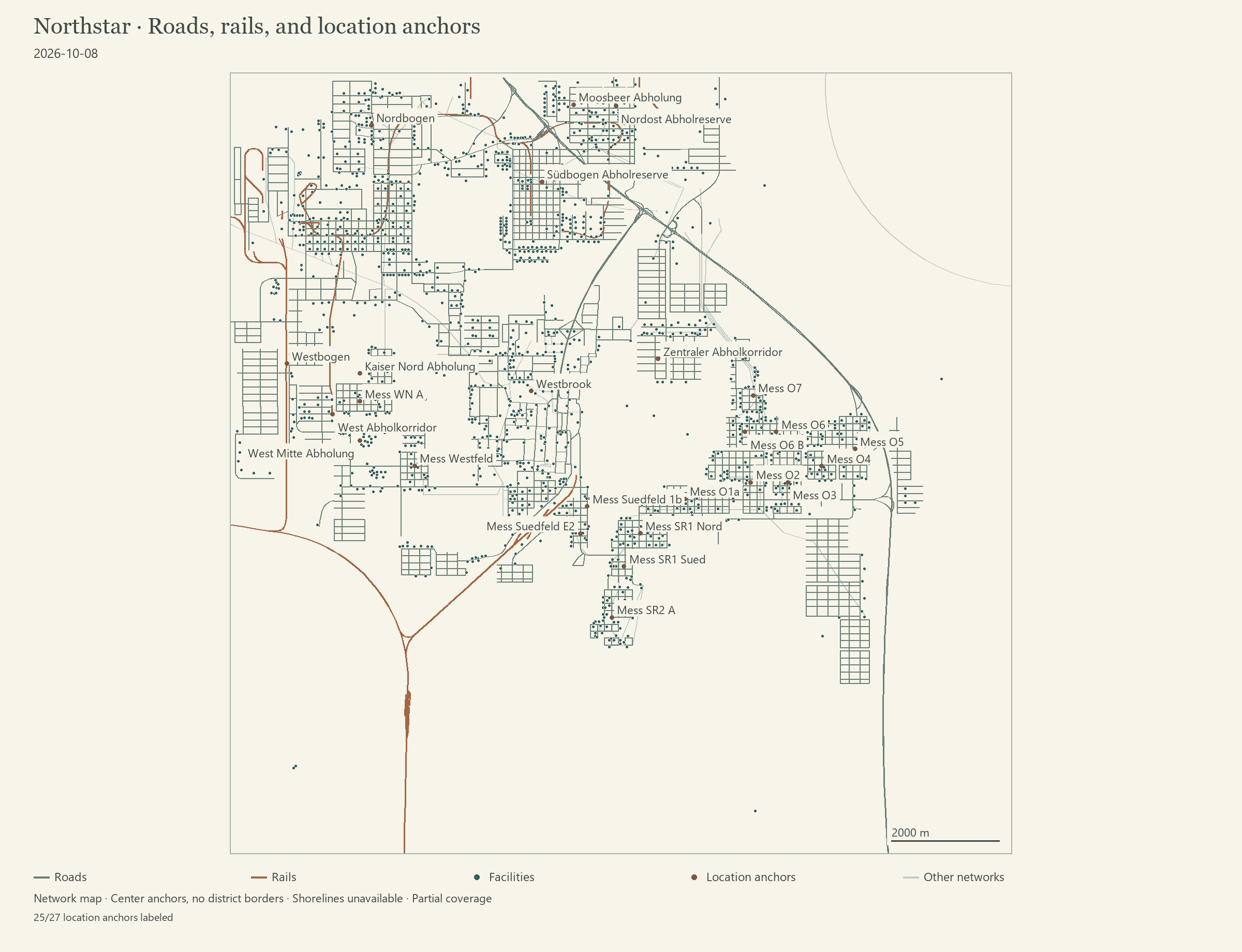
The western trials concern the district West Mitte Abholung, neighbouring western service routes and the later district West Sued Abholung. Kaiser Nord Abholung lies further north. Freight terminals and industrial areas in the northeast form the second centre of goods traffic.
Eight identical hearses: the return trip is its own bottleneck
In the southern west, the same vehicles were read twice, at 20:17 and 20:18 UTC. Eight identical hearses had the same position and speed zero in both samples. Most of them were loaded and on the way back. Other vehicles of the same fleet moved between the samples.
This shows a concrete delay in place and operation. It does not prove a permanent standstill of all vehicles, and identical end positions do not fully rule out movement in between. At the southern junction of Frühlingsstraße the game's own flow index and lane congestion value were read (see table). Both are game indices, not vehicles per hour counted by the project. Here they tie the problem samples to a loaded road section. The exact blocking sequence and turning conflicts remain to be examined.
A preview for a double public-transport lane on this section was permitted by the game and planned no demolition of original buildings. It still affected more than 900 original objects, of which only 64 were delivered individually, and the effects on neighbouring buildings and zones were incomplete. The building agent did not apply it. That is a decision after reviewing consequences, not a measured failure of an existing lane.
Regional assignment works without repairing the shared route
A western facility was assigned to the nearby district West Mitte Abholung. In a comparison over about seven and a half minutes, four identical vehicles changed from pickup jobs to loaded return trips. The facility later received an additional garage, and its actual fleet grew.
For West Sued Abholung, another facility that had served the whole city was assigned to the region. One identical vehicle was sent to the new area, then seen loaded on the way back, and afterwards observed on a trip to a further house in the same area. That is a regional operating loop; the unloading or processing of the first person targeted is not fully documented.
The move to smaller areas followed the finding that nearby facilities also served distant jobs. New nearby jobs are an interim proof, but they do not resolve a shared return node. This is why new jobs and persisting congestion can be seen at the same time.
Waste collection: short straight line, long planned path
A recycling centre was assigned to Kaiser Nord Versorgung, Kaiser Nord Abholung and Mess WN B/C. One moving vehicle had a target in the new area. In the context of a collection round, its stored path distance was about 7.8 kilometres, while the target lay only about 840 metres from the depot in a straight line.
These are different quantities. The path distance is a stored planned route, not a distance measured afterwards, and the straight line is no drivable shortcut. A new link would have to join roads that actually accept traffic and account for its effect on existing facilities. A direct road connector that was examined collided with an ore area and a cemetery, and its change consequences were truncated. It was not built.
Another recycling centre was assigned late to Kaiser Nord Abholung only. Five identical parked waste vehicles stayed parked in the following window: a change of service area is not yet evidence of new pickup. Other citywide supply remained, but no secure total reserve can be calculated from it.
More buses: measurable expansion, depots still fully used
Two new free bus lines joined operations: Bus 13 to the northeastern industrial stop and Bus 14 from Krähenstraße 516 to two existing stops. Both carried passengers. A vehicle assigned to a line is not the same as a depot vehicle actually available.
An additional garage raised the capacity of one depot (see table). A snapshot of Bus 14 afterwards recorded passengers and people waiting; it documents operation but does not explain the fluctuating demand or work arrivals. Late in the evening both depots held 45 buses of their own and no parked vehicle.
On Bus 7, several of the active buses had speed zero at that moment. All stop orders were compared; the existing loop was already the shortest of them and stayed unchanged. More vehicles on the target setting or a longer order would not prove a free depot reserve or faster shared access roads.
Cheap freight does not arrive through a new train line alone
Rail distribution received new and changed relations. The newly set up Cargo 12 between a cheap ore terminal and Zentral is short, about 5.2 kilometres per loop. A real train and changing loaded trips are documented. The observed cargo included cotton but no ore, so the measure is not yet an accepted ore delivery solution.
Elsewhere, two identical ore-buying firms had clearly lower costs and lost their warning; their last stored trading partner was a freight terminal. Other buyers stayed expensive. One buyer followed closely got a higher stock during the day and kept producing, while its raw purchase cost value stayed above the warning threshold of 5. Goods available and cheap procurement are different outcomes.
Order quantity, freight assigned to a vehicle, goods physically loaded, loaded return trip and final arrival must therefore each be documented. An empty vehicle with assigned cargo is not a completed pickup, and a fully reserved terminal stock is not a reserve that is freely available. Price or warning changes before the new train service must not be credited to it afterwards.
Exact values
| Measure | Value |
|---|---|
| Flow index, southern Frühlingsstraße junction | 0.127 |
| Lane congestion value, same junction | 0.965 |
| Stored path distance, recycling vehicle | 7.789 km |
| Straight line to the target | about 840 m |
| Depot capacity after extra garage | 35 to 45 places |
| Cost of the garage | 75,000 game money |
| Fleet of the western facility after its extra garage | 15 to 20 |
| Bus 14 snapshot | 3 active buses, 21 passengers, 71 waiting |
| Bus 7 loop | 5.266 km |
| Cargo 12 loop | 5.192 km |
| Raw purchase cost value of the buyer followed | 5.144 (warning threshold 5) |
Where things stand
The work so far produced nearby jobs, a larger bus fleet, observed freight and a cemetery that accepts again locally. It has not produced a lasting traffic or supply solution for the whole city. For service routes, a repeated regional loop through return and processing, together with a falling backlog of the same cases, would count. For buses, real loops, sufficiently served stops and documented passenger or work trips would have to be shown. For goods, identified cheap deliveries to the same buyer and their renewable supply would count. Safe road changes with complete consequences and depot sites still have to be found. The windows are uncontrolled and not atomic, and restorations limit long-term comparisons.