Northstar above two million again, supply problems remain
Listen to this post10 min
Created by AI from the text of this post and read by a synthetic voice; not a word-for-word version, and it may contain errors.
Loading…
Created by AI from the text of this post and read by a synthetic voice; not a word-for-word version, and it may contain errors.Position and speed stay in this browser and are sent nowhere.
The recording could not be played. Open the audio file
Northstar's last verified evening reading on 10 October showed about 2.1 million residents, so the two-million mark was crossed again. Holding it is not shown: the city was briefly below it in the early afternoon and fell back later too. A textile plant resumed production, but its purchasing-cost warning remained. The closing balance was negative, and the combined goal of two million residents at under 30 percent CPU load is still not demonstrated.
Population: four readings, no daily curve
Four original readings give dated orientation. All times are UTC; Berlin was two hours later.
| Time on 10 October | Actual residents | Chosen speed setting |
|---|---|---|
| 12:11 | 1,964,004 | 1 |
| 12:52 | 1,945,081 | 1 |
| 14:23 | 2,007,418 | 1 |
| 21:48 | 2,098,397 | 1 |
These are single observations, not a full daily curve and not daily extremes. In the evening, rising and falling short windows stood side by side. Rolling back a failed construction attempt by loading the saved earlier state also changed the world identifier, so no continuous growth rate is calculated across that boundary. A net rise does not prove that nobody left.
Jobs: vacancies and unemployment together
The closing reading, shown in the table below, listed vacancies and unemployment side by side. About 85 percent of the vacancies were for well or highly educated workers; only 49 were listed as wholly uneducated. More residents alone therefore do not guarantee that positions get filled.
A paper plant on Erlenstraße showed a different problem: two of its vacancies called for poorly educated workers, so the general warning about missing uneducated staff was too coarse for the diagnosis. Its staffing rose later, but its job capacity changed at the same time, so no success of the new bus link can be isolated. A clinic had no staff and a disconnected power connection; the neighbouring transformer was destroyed by fire and not yet released for rebuilding. Two examined schools had no staff. A positive citywide power balance does not prove these buildings are connected. Proposed connections and repairs were held back where the full consequences were not established.
Education and bus line 12
The education budget was raised from 100 to 125 percent and later to 150 percent. The first step raised the measured monthly education upkeep, and it was higher still at 150 percent. Two examined universities showed higher efficiency and slightly more students and staff after the first increase. These are operating observations, not additional degrees or confirmed job starts. The second change also ended the unchanged comparison of the first step.
For the industrial area, two stops were built on Erlenstraße. New bus line 12 links them to the existing Wiesenstraße stop, which already has a bus line and lies near the subway. Closer rail stations turned out to be freight stops and are not presented as passenger connections. After a full route check the stop order was changed, which shortened the loop to just under 9 kilometres. The fare was set to zero. Seven actual buses were confirmed on the line, which ran day and night, and some buses were still on the long drive from the depot. A shorter loop and an active fleet do not prove that particular workers reached their jobs.
Cotton: productive plants, no sufficient breakthrough
Cotton plants, among them sites on Kümmelstraße, north of Kaiserstraße and on Breitstraße, became productive. The first small plant yielded little, so work moved to more fertile soil and larger usable areas. A placed placeholder object was explicitly not counted as finished extraction.
The build north of Kaiserstraße deliberately replaced four previously examined residential or mixed buildings, affecting about 260 residents. Where these people went is not established. Another attempt, replacing four office buildings with a cotton placeholder, was rolled back via the saved earlier state because no productive plant had resulted. The finished farms left the supply gap open. Citywide production, smoothed statistics, capacity and consumption are separate measures, and field previews show stock, not a production rate. It is not yet shown that more extraction reliably lowers purchasing costs at the warned factories.
Freight rail and a textile plant
Two existing freight lines were switched to regional distribution. One now links a western station to the central one; the other runs between the northern and central stations. Existing track was used and no new stations or routes were built. The second line had four actual trains after the change and was later reduced to three. Neither line load nor fleet size proves unloading at the right factory, and a CPU or price improvement from the pilot is open.
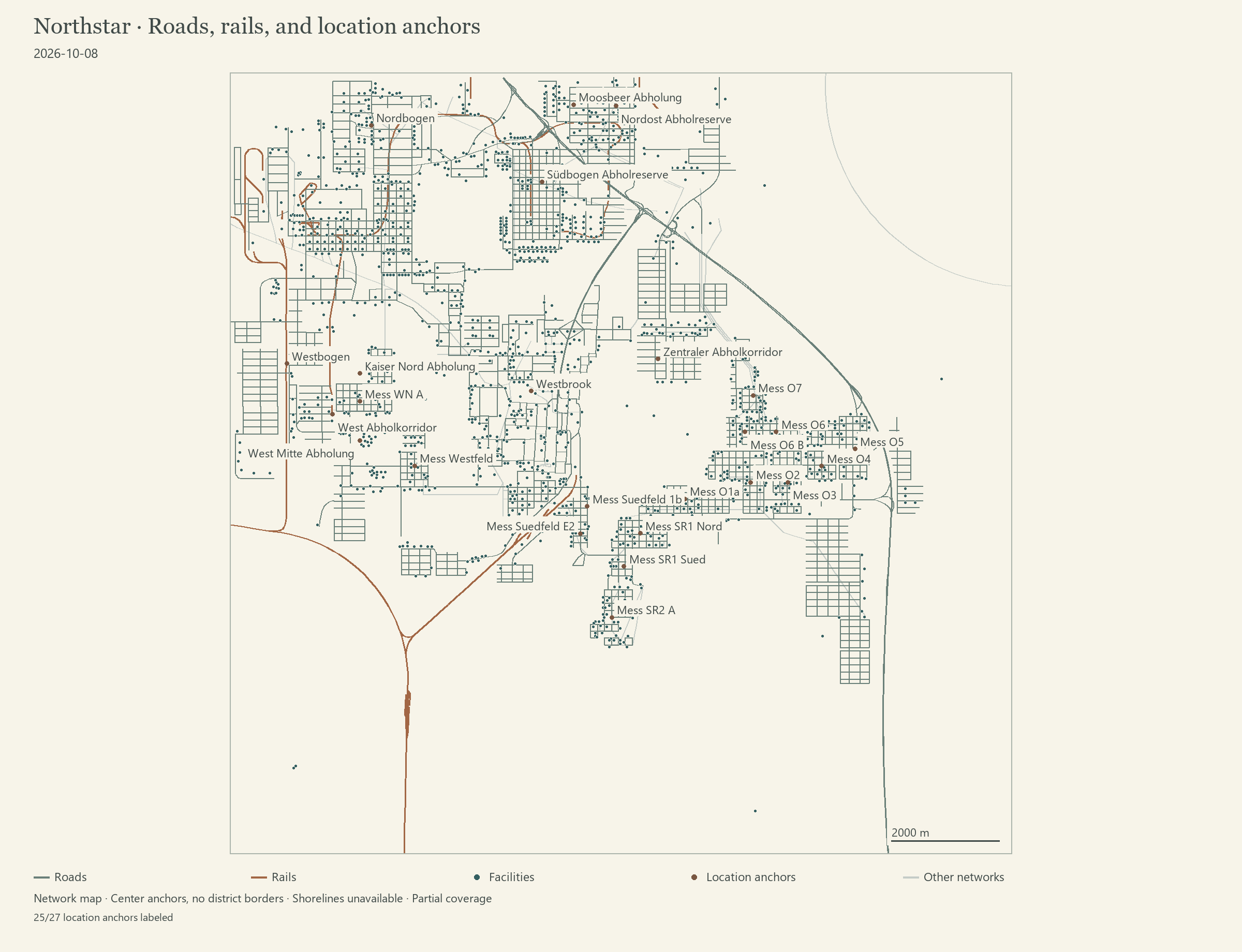
At 21:17 UTC a textile plant had no cotton stock and no production. A loaded buyer truck was followed on its way back; it stopped repeatedly in the Bach corridor and later moved on. Later in the evening the plant held cotton stock and positive production, and a further sample confirmed continued production. The pattern fits a return of goods, but no single authoritative unloading event exists. Purchasing costs stayed at about 5.5, above the read-out warning threshold of 5, so the refilled stock did not clear the cost warning. At the four-armed junction Bachstraße/Erlangenstraße a regular traffic light was added; the main arm stayed heavily congested. The flow index read out is not a count of vehicles handled, so the light is not taken as sufficient relief or as the proven cause of the goods' return.
Housing, ruins and the financial price
In the evening about 170 previously free cells were zoned for medium-density housing, in the south and the north, along existing roads. Later inspections found eight new buildings, some no longer under construction, with households and citizens living in them. That shows occupants, not additional job starts or net immigration. Power, water, sewage and road connections were present; foot access stayed undetermined. Three empty abandoned ruins were removed, and the retained zoning then led to three new houses under construction. Other ruins and damaged service buildings were left alone.
The residential tax was lowered in two steps, finally to zero percent; a claimed work refusal because of low taxes is not documented. Later the office rate fell from five to four percent as a time-limited cash-flow pilot.
| Closing reading | Value |
|---|---|
| Cash | 1,996,685,238 game money |
| Credit | none |
| Monthly balance | −13,061,501 |
| Vacancies | 51,655 |
| Unemployment | around 11.88 percent |
The desired cash corridor was missed, as was the long-term balance.
Where things stand
The verified performance file for the Berlin day holds 2,730 raw readings and one explained gap; every stored speed setting was 1. That does not rule out unobserved changes in between, and no robust CPU reduction below 30 percent at comparable simulation throughput exists from these measures. The regular daily data export was not complete at the editorial cut-off; six invalid source files blocked the dispatch. Open: sustained two million residents, the cash corridor, the long-term balance, and lower purchasing costs at the warned factories.