Northstar's public transport: what was built and what runs on 7 October
Listen to this post8 min
Created by AI from the text of this post and read by a synthetic voice; not a word-for-word version, and it may contain errors.
Loading…
Created by AI from the text of this post and read by a synthetic voice; not a word-for-word version, and it may contain errors.Position and speed stay in this browser and are sent nowhere.
The recording could not be played. Open the audio file
Northstar's public transport is now a network of buses, three metro lines and two passenger rail links to the outside. It grew in different kinds of steps: putting existing stations into service, building stations and tunnels, connecting depots, adding lines and redistributing vehicles. The state described here is 7 October 2026. The stated intent is to relieve roads and enable growth. Ridership readings show use, not avoided car trips or CPU savings, and the goal of at least two million simulated residents with congestion reduced remains open.
Public transport: vehicles actually active in dated samples. Values per step in vehicles: Bus 4 4, Bus 1 6, Bus 6 11, U-Bahn 1 8, Personenbahn 1 1, Personenbahn 2 1, Bus 3 8, Bus 2 10, U-Bahn 2 9, Bus 5 5, U-Bahn 3 4, Bus 7 4, Bus 8 6, Bus 9 · 09:21 UTC 3.
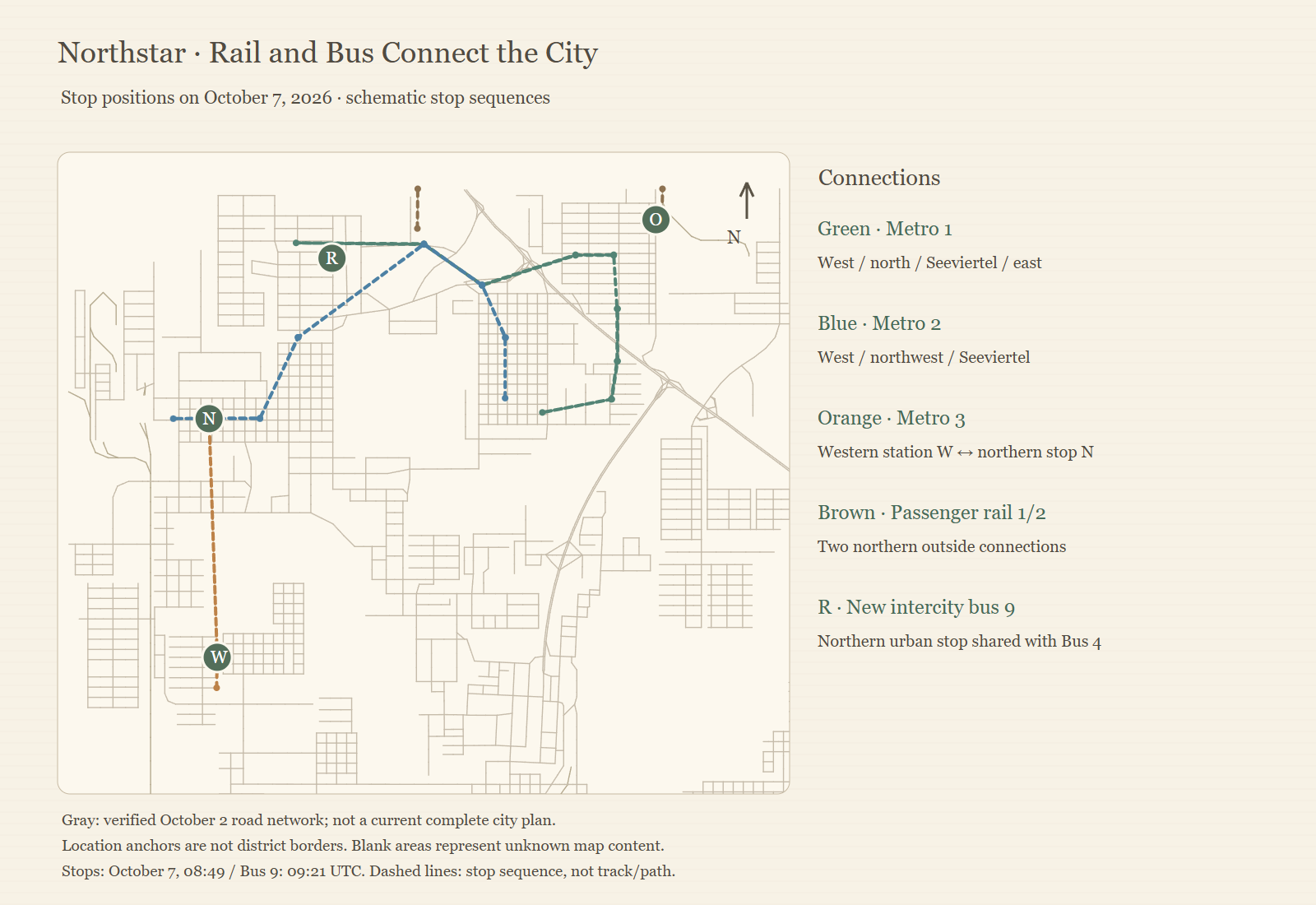
Orientation: rail axes and feeders
How it was built
On 27 September a metro depot was built on the existing western route and a line was put into service over four stations that already existed. No four new stations were built there. Later that day the construction logs record new passenger rail stations in the north-east and north-west with external connections, plus six metro stations along the axis from the north-west to the centre and the lakeside districts. The line operating at that time did not serve all six new stations: a built station and a stop actually served are different things.
On 29 September the working log records an eastern expansion with new stations and tunnel sections, and a long line. That describes the documented construction section, not today's fleet or any road relief at the time. No complete chronology of each original bus line's first construction is available.
On 5 October a new west station near Eiswald received an underground connection to an existing northern stop. Metro line 3 started with two trains. Occupancy readings in the dated sequence rose over that period, which documents use, not a count of newly carried people or avoided cars. West bus 5 had a longer circuit in the same work section; because the stop sequences differ, the two cannot simply be compared by travel time. Depot capacity was raised slightly and a missing main connection was made. An expansion side port remained problematic, so nominal depot capacity is not freely available reserve.
On 6 October existing trains were redistributed between lines. That was an operating change within the real fleet, not a build of new trains. The full reading of 7 October shows a different distribution again, and older distributions are not carried forward as today's state.
Bus changes on 7 October
Bus 5 received an additional return stop at Weitenstraße 122. The insertion first lengthened its circuit, which was then shortened again by checking all cyclic orderings of its five stops. That is a limited route optimisation, not a claim of global optimality. The old stops were kept, and the fleet was reduced step by step to five buses. It is free and runs day and night.
Bus 7 serves as a western residential feeder to metro line 3. Passengers were on board at 04:29 UTC after start-up. Waiting counts first fell sharply, then fluctuated again. No individual transfer chain to the metro and no counted avoided car trips were shown.
Bus 8 runs from Kornfeldstraße Süd via Freudentalstraße am Ostbahnhof to Kornfeldstraße Nord; the two Kornfeldstraße stops are on different sides of the street, and the sequence takes account of the one-way street at the station. Its full circuit is shorter than the other fully qualified cyclic variant. No global shortest route was claimed and no road extension was built. The line began with three buses and, after the first operating test, was reinforced; further vehicles were still on their way from the depot at the fleet check. The bus stop is around 72 metres in a straight line from the station centre and around 16 metres from the metro stop. These are straight-line distances, not measured walking paths or secured transfer times.
The new bus 9 shares an existing northern city stop with bus 4 and serves the directed outer stops. Its circuit is roughly half as long as that of coach line 2, which remains. The city stops differ, so equal door-to-door performance does not follow. The line was recorded at 09:21 UTC with its three buses; passengers on board and waiting are in the table. The new link supplements the central coach stop and does not replace it.
Operating state
All rows except bus 9: 7 October, 08:49 UTC, complete single-frame reading. Bus 9: 09:21 UTC, a non-atomic line list; its fleet was additionally checked in full. Fares are in game money; all lines run by day and night.
| Line | Stops | Active vehicles | On board | Waiting | Nominal capacity | Full circuit | Fare |
|---|---|---|---|---|---|---|---|
| Metro 1 | 16 | 8 | 2,506 | 1,271 | 8,640 | 15.431 km | 0 |
| Metro 2 | 14 | 9 | 4,460 | 3,606 | 9,720 | 15.228 km | 0 |
| Metro 3 | 4 | 4 | 739 | 107 | 4,320 | 7.349 km | 0 |
| Passenger rail 1 | 2 | 1 | 3 | 89 | 840 | 0.833 km | 0 |
| Passenger rail 2 | 2 | 1 | 124 | 90 | 840 | 0.973 km | 0 |
| Bus 1 | 6 | 6 | 247 | 97 | 480 | 5.325 km | 0 |
| Bus 2 | 3 | 10 | 222 | 215 | 800 | 16.39 km | 0 |
| Bus 3 | 4 | 8 | 502 | 286 | 640 | 7.613 km | 0 |
| Bus 4 | 6 | 4 | 85 | 104 | 320 | 3.889 km | 0 |
| Bus 5 | 5 | 5 | 57 | 37 | 400 | 11.43 km | 0 |
| Bus 6 | 4 | 11 | 339 | 227 | 880 | 20.655 km | 0 |
| Bus 7 | 4 | 4 | 64 | 181 | 320 | 5.266 km | 8 |
| Bus 8 | 3 | 6 | 7 | 18 | 480 | 3.586 km | 8 |
| Bus 9 (09:21 UTC) | 3 | 3 | 98 | 122 | 240 | 7.692 km | 0 |
The complete list of 08:49 UTC holds freight lines as well as passenger lines. With bus 9 added, a later list holds one line more, captured over several frames and not an atomic total. Filter readings around 08:50 UTC show no active aircraft or ship lines, which does not prove that airport or harbour buildings are missing. No tram line appears in the complete 08:49 list.
Where things stand
Passengers on board and waiting are snapshots, not daily ridership or people per hour, and nominal capacity is no guaranteed peak capacity. The readings confirm infrastructure, active vehicles and use. Open are complete circuits, transfer paths actually reached, and a reliable relief effect on roads and computing load.
Public transport: passengers on board as a snapshot. Values per step in people: Bus 4 85, Bus 1 247, Bus 6 339, U-Bahn 1 2,506, Personenbahn 1 3, Personenbahn 2 124, Bus 3 502, Bus 2 222, U-Bahn 2 4,460, Bus 5 57, U-Bahn 3 739, Bus 7 64, Bus 8 7, Bus 9 · 09:21 UTC 98.
Public transport: waiting passengers as a snapshot. Values per step in people: Bus 4 104, Bus 1 97, Bus 6 227, U-Bahn 1 1,271, Personenbahn 1 89, Personenbahn 2 90, Bus 3 286, Bus 2 215, U-Bahn 2 3,606, Bus 5 37, U-Bahn 3 107, Bus 7 181, Bus 8 18, Bus 9 · 09:21 UTC 122.