Northstar, 6 October: one crematorium reassigned, a detour planned but not built
Listen to this post9 min
Created by AI from the text of this post and read by a synthetic voice; not a word-for-word version, and it may contain errors.
Loading…
Created by AI from the text of this post and read by a synthetic voice; not a word-for-word version, and it may contain errors.Position and speed stay in this browser and are sent nowhere.
The recording could not be played. Open the audio file
Between the first stored reading on 5 October and the last on 6 October, Northstar's population went from about 1.86 million to about 1.79 million. That endpoint difference is not a midnight balance, not a pure migration balance and not proof of cause for any single measure. Two million was not reached in this series.
Population on October 6. Residents from the published series, 74 readings from 5 October 2026 to 6 October 2026.
Funeral services: an existing facility instead of a new one
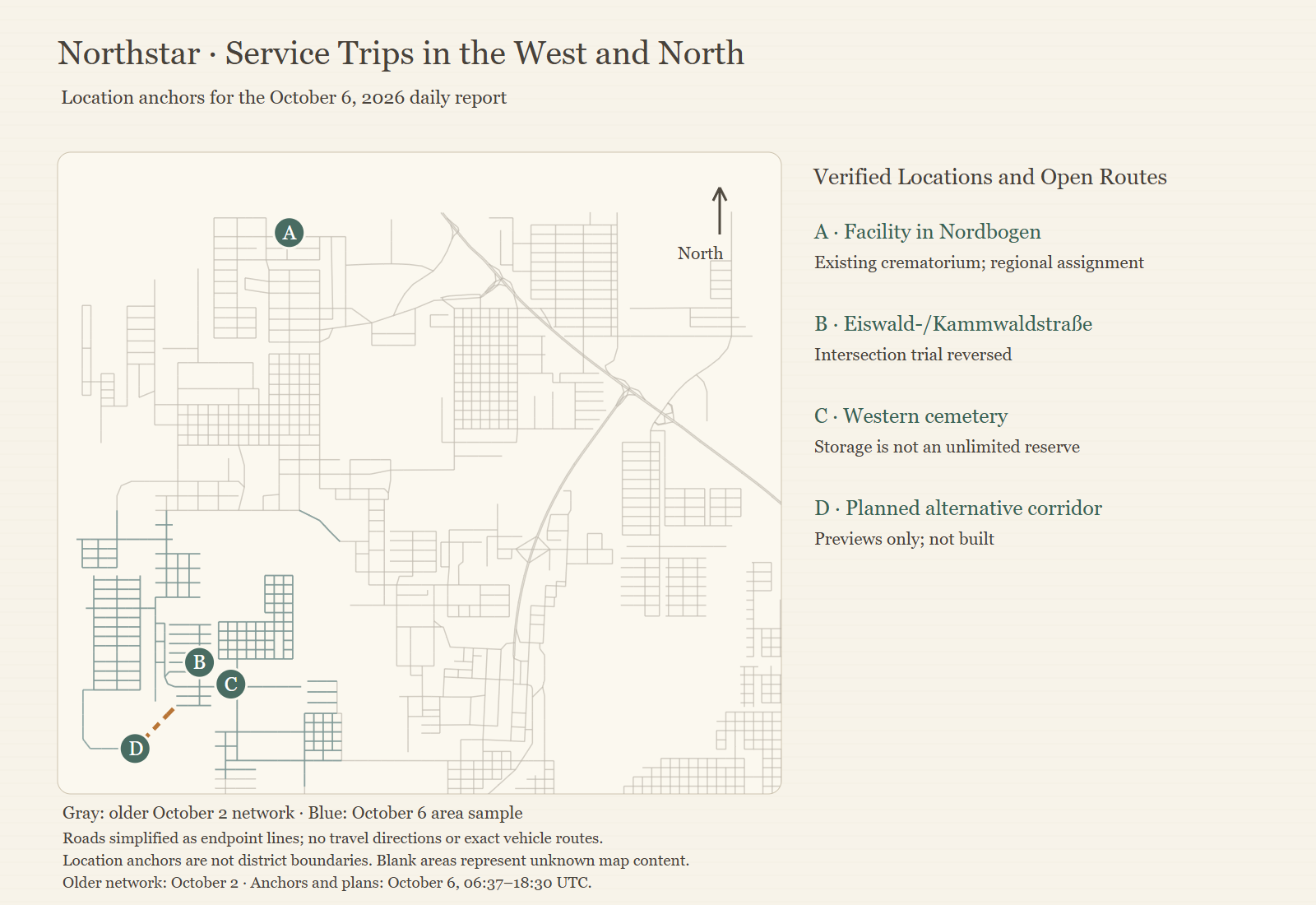
In the afternoon the building agent assigned an existing crematorium in the north arc to that one district; before, it had worked without a district restriction. Two findings decided it: the facility and real hearses parked there already existed, while the preview of a new building showed overlaps and incompletely determined effects on existing buildings. Two other local facilities stayed citywide, and an existing north-arc assignment was not changed.
A short afternoon sample followed the same five hearses. For one, the transition to a pickup is strictly confirmed. A second shows the same loaded-return pattern but also carries a contradictory target marking, so it does not count as secure. For the other three the outcome is unknown. The sample shows neither two completed pickups nor processing or daily throughput.
The west in the evening
Early in the day an existing western crematorium received the additional district West Abholkorridor and kept its earlier assignment. The read-back at 01:16 UTC shows both. Assignment alone does not guarantee a short or free route, so vehicle roles and loaded returns were checked.
In the evening, four western facilities were observed over a window of about two minutes. Seven transitions to pickup were confirmed independently against raw records: the same hearse with the same deceased person was first recorded as dispatched, then as returning and transporting, with its facility as the return target. That is not seven completed processings, not a lasting rate and not a general absence of congestion. At one facility a hearse appeared while another vanished, so fleets were not identical throughout. For the remaining cases the outcome is unknown, not zero. Loaded facilities and full cemeteries remain. Cemeteries offer finite storage and crematoria process; the two are not the same. The western cemetery storage expanded the day before is not an unlimited free reserve either.
A western detour: planned, not built
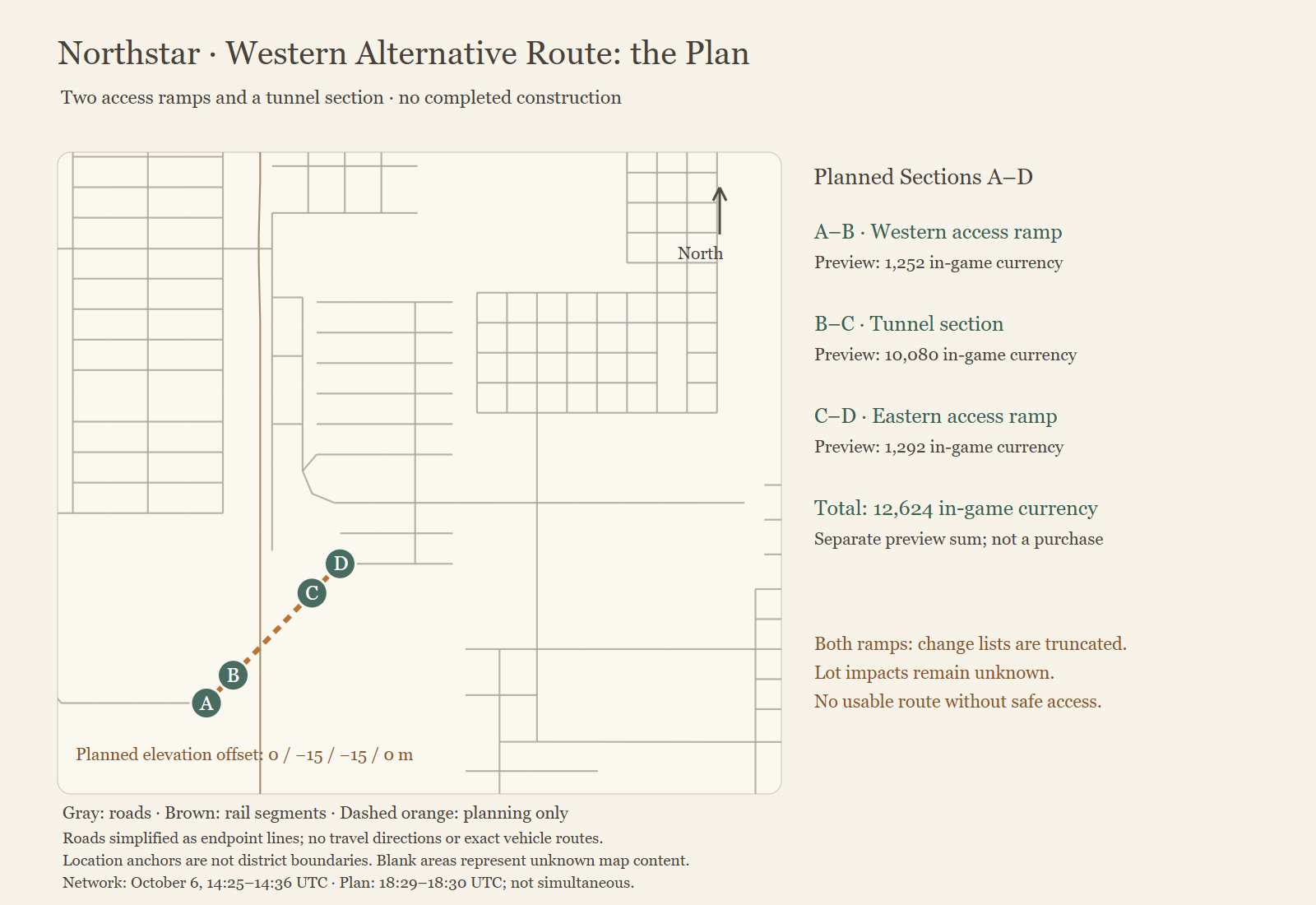
The analysis rested on complete data from four sub-areas, together a few hundred road edges and nodes in a geometric model. The sub-areas were read at different times in the afternoon; there is no simultaneous full snapshot, and directions of travel, turning rules and vehicle rights are not fully known.
The building agent checked whether mathematically independent paths exist, because two paths sharing the same inner bottleneck offer no independent substitute if it fails. Two paths that are separate in a simplified two-way model do not show that the real building access is legally reachable. The chosen candidate joins a western and an eastern road anchor, about 823 metres apart in a straight line. That is neither road length nor travel time nor a globally optimal route. A northern variant would have deleted three industrial buildings and was not built. For the chosen candidate, an ordinary land purchase removed an obstacle at the city boundary; that is not road construction.
Later the candidate was planned in detail: two ramps and a tunnel middle section, in separate previews made within about a minute of each other in the evening. The previews were formally permissible and listed no deletions of original objects, but each ramp contains roughly 90 changes to original objects, with truncated lists and unknown consequences for plots. The middle section contains none. No construction price was paid, and in the completed, evaluated corridor run no section was built. Limited, necessary demolitions are permissible in principle; here the unknown concrete consequences of the ramps for existing buildings prevented construction. A tunnel middle section without secure access would not have produced a usable route. A small pedestrian street suited to service use was examined as an alternative, again only as a preview with incomplete consequences for existing buildings.
6 Oct 2026: sampling times of the day (UTC): 01:16 Western crematorium: both districts read back; 14:25–14:36 Four western sub-areas read at different times; 16:54–16:56 Northern arc crematorium: sample, one pickup transition confirmed; 18:29–18:30 Western detour: two ramps and tunnel section previewed, not built; 19:41–19:43 Four western facilities observed in a short window.
Reversible junction trials
A signal test ran in the morning at the Eiswald/Kammwald junction, another in the evening at the Rotbeeren junction. In neither case could relief be shown. The original states were restored and neighbouring buildings and network checked. That a single congestion marker disappeared was not enough as evidence. The limited current samples did not justify keeping the changes. This does not mean signals are unsuitable in general.
Public transport
Bus line 5 showed neither passengers nor waiting people in several stored samples. Over the evening its active vehicles fell to fewer than half of the earlier number, while the free Metro line 3 runs in parallel. The main depot's actual fleet stayed unchanged at 21 trains; one train earlier seen on line 1 was now seen on line 3. No new train was created. An effect on traffic or on CPU time per unit of simulation work is not shown, nor is a sufficient frequency. A second depot with two parked trains has no effective rail access and is not a demonstrated reserve. A proposed shortening would have saved only about four metres by the preview and was not applied.
Buildings and supply
In the evening three empty, abandoned ruined homes were removed in the regular way; none had residents, households or employees, and the remaining checked local buildings and zoning stayed. Population was not removed on purpose as relief. Rebuild previews for a destroyed post office and a gas power plant showed incomplete consequences and were not applied; no citywide outage of post or power follows from that. A complaint about water quality is open as a task to check; sufficient capacity does not show drinking-water quality.
Daily data
| Measure | Early reading | Late reading |
|---|---|---|
| Residents | 1,858,410, 2026-10-05 22:06 UTC | 1,793,515, 2026-10-06 21:58 UTC |
| Actual jobs | 821,096, 2026-10-05 22:06 UTC | 810,138, 2026-10-06 20:59 UTC |
| Unemployment rate (%) | 14.35, 2026-10-05 22:06 UTC | 16.36, 2026-10-06 20:59 UTC |
The daily file shows no flagged grid gaps, but a series without gaps is still not continuous observation. The separate performance file has a small number of flagged gaps. No isolated, controlled evidence shows that the service measures lowered CPU time per unit of simulation work.
Where things stand
Single confirmed pickup transitions are shown, not their throughput. Still open are the actual driving distance, handover and processing, behaviour at peak load, a freely reachable reserve and a secure, complete detour. Only then can sustained growth or a gain in computing load be judged.
Actual Jobs and Unemployment Rate. Jobs and Unemployment rate (%) from the published series, 45 readings from 5 October 2026 to 6 October 2026.