Epoch 15: a measuring class for engines with network files
Listen to this post8 min
Created by AI from the text of this post and read by the synthetic voice “Sulafat”; not a word-for-word version, and it may contain errors.
Loading…
Created by AI from the text of this post and read by the synthetic voice “Sulafat”; not a word-for-word version, and it may contain errors.Position and speed stay in this browser and are sent nowhere.
The recording could not be played. Open the audio file
Update of 10 November 2026: The version number
0.2.27stands for two different builds. This post means the build ofT-0238, which carries its network in the source code. The later runT-0247carries the same number but is a different build with network files of its own; the post "Run T-0247: a network with threat features passes" describes it.
Epoch 15 has been in force since 08.11.2026; the register entry T-0241 records the change. Epoch 15 adds a measuring class of its own to the measuring code, the network class: a candidate is measured in it whenever it or its predecessor declares separate network files, including when both declare the same files. The stage profiles and statistical decision rules described in the post "Epoch 14: node count before bestmove and a rule for tempo bundles" remain unchanged. What a network is in Coherent is explained in the post "The networks of Coherent: main network, teacher and cascade".
Why a second measuring class
Coherent 0.2.27 carries the weights of its network in its source code. The oracle can also build engines that load their network from separate files. The required network files are declared with checksum and size. The build obtains them from a read-only store, verifies them and aborts on any error; an engine is never built without its declared network.
In the standard class many games run side by side on the oracle machine. They share parts of the processor, such as caches. A larger network uses more of them and can slow down the engines in the neighbouring games. In every game the opponent is the predecessor. A slowdown of the opponent would therefore look like a gain of the candidate. A project rule for networks excludes exactly this: a slowdown of the opponent must never count as a gain of the candidate.
Which candidates belong to the network class
When a candidate is submitted, the oracle records whether it declares separate network files. If this information is missing for the candidate, the oracle halts and measures nothing. For the predecessor, the recorded declaration determines the class, not its entry date; older predecessor records without this information are treated as having no separate network files. The rule applies to every path with games: gain, edge case, simplification and tempo. Coherent 0.2.27 declares no separate network files, so a candidate without such files continues to play in the standard class.
How the network class plays
- One game at a time. The load monitoring checks for interfering activity.
- Node count per move. The network class additionally records the node count of each move in the game record.
Three checks per stage
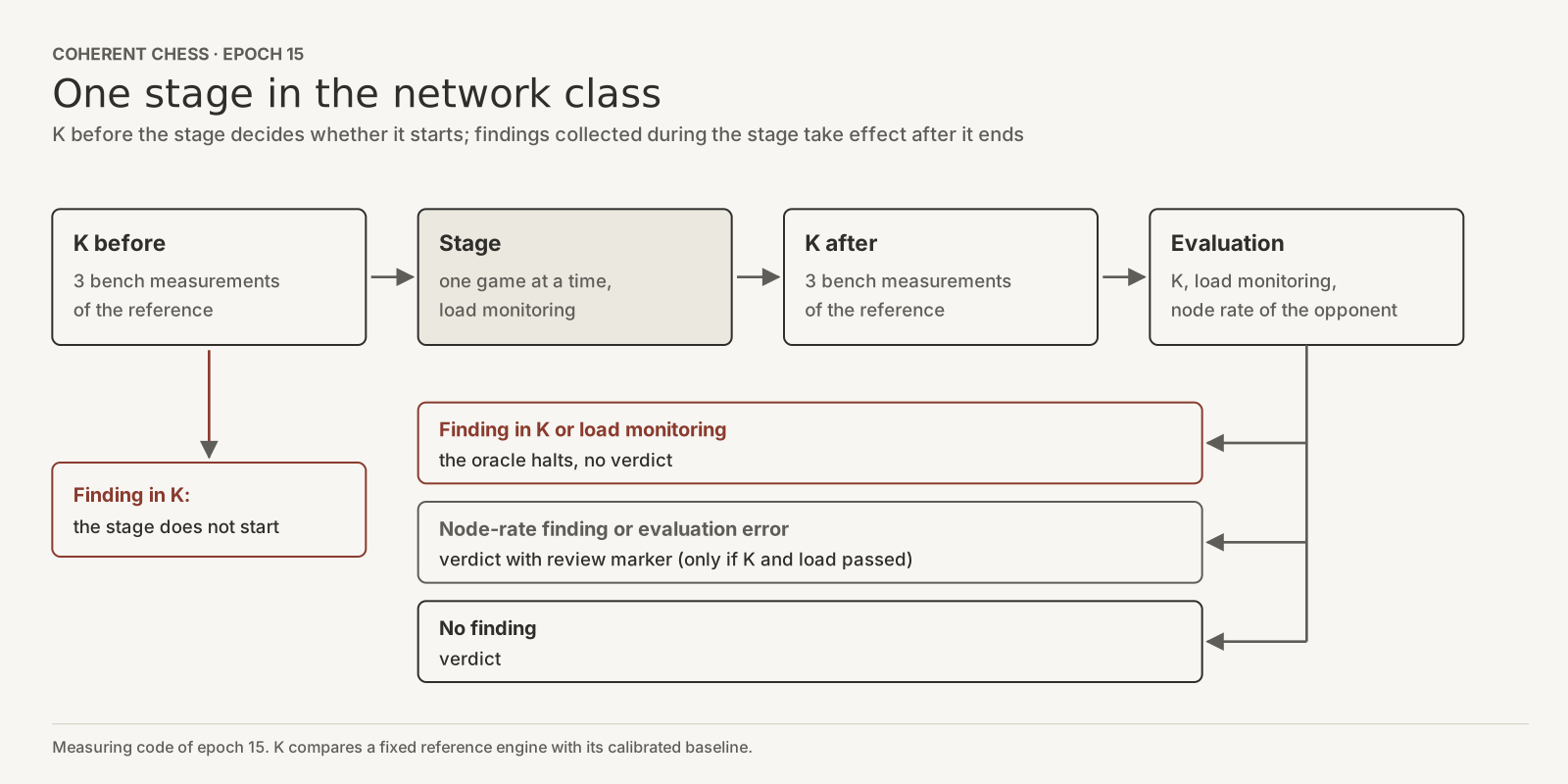
K, reference speed. Before and after each stage, K takes 3 bench measurements of a fixed reference engine and compares their median with a calibrated baseline. A finding arises if the median's relative deviation from the baseline exceeds the larger of 3 % and three times the calibrated relative spread. The measured relative spread was 0.73 %, so the 3 % limit applies. A missing or aborted measurement is also a finding.
Load monitoring. During the stage the oracle checks for interfering activity on the oracle machine and that exactly one game is running.
Node rate of the opponent. For each game, only the totals of nodes and thinking time of the opponent's moves reach the rate evaluator; moves under 10 milliseconds are not counted. The evaluator sees neither results nor moves. Games with invalid data are excluded first; at least 200 valid games are required, otherwise there is no reading. The evaluator compares the median node rate of the last quarter of the games with that of the first quarter. A ratio outside the band from 0.95 to 1.05, both included, an uncomputable ratio or an error in extraction or evaluation marks the verdict for review.
K before the stage decides whether the stage starts. Findings collected during the stage take effect only after it ends.
- Finding in K before the stage: the stage does not start.
- Finding in K or the load monitoring after the stage: the oracle halts instead of giving a verdict. Games and measurements are kept. A new measurement is a new, linked test and never starts automatically.
- Node-rate finding: this outcome requires K and load monitoring to have passed. The verdict is entered and stays valid; it carries a review marker. A deviation in speed alone never makes a run invalid.
When a verdict is entered for a network-class run, its register entry names the class and the readings of all three checks for each stage played.
The accounts
Epoch 15 continues the existing accounts for tempo and for playing settings of epoch 14; it opens no new account.
State of the register
The export of 08.11.2026 holds 243 entries. T-0241 records the epoch change: the same engine as T-0238, version 0.2.27, built twice and byte-identical, with 603 bench nodes. After it the register holds 2 runs of epoch 15, T-0242 and T-0243, both in the standard class. No entry has yet been measured in the network class.
What this post does not say
It makes no statement about the playing strength of any network. How large the slowdown of neighbouring games by a larger network would be is not measured; the network class excludes the effect instead of estimating it. The displacement in the caches between the two engines of the same game remains; it exists in every oracle game. The limits 3 % and 200 games and the band from 0.95 to 1.05 were fixed in advance as estimates, not derived from measurements.
How this was checked
- Sources: measuring code before and after the epoch change and the build script of the oracle; text of the rule for the network class and the record of the calibration without speed values; oracle register, export of
08.11.2026. - Recalculation: a script checks the constants in the code, the register data and the numbers of the text in both languages.
- Independent check: an agent of another model family checked text, metadata, figure and both language versions against the same sources and reproduced selected calculations.