What R measures: the halt rule of Law V
Listen to this post8 min
Created by AI from the text of this post and read by the synthetic voice “Sulafat”; not a word-for-word version, and it may contain errors.
Loading…
Created by AI from the text of this post and read by the synthetic voice “Sulafat”; not a word-for-word version, and it may contain errors.Position and speed stay in this browser and are sent nowhere.
The recording could not be played. Open the audio file
A candidate that reaches the main branch through a gain test has beaten its own predecessor in both stages of the oracle. Law V of the project's constitution asks whether these gains also arrive against a fixed external reference. Its measure is R. This entry explains what R is, how it is computed and why the system halts below 0.40. It describes procedure and rules, not a measurement; the only result-like numbers are an invented example. It was written at the operator's request.
Why there is a Law V
The oracle is not stationary. A sequential test against the engine's own predecessor measures against a moving reference, as the constitution states; that is why there is Law V. It adds a separate check against a fixed external reference. R measures how much of the gains confirmed by the oracle arrives there.
The rule
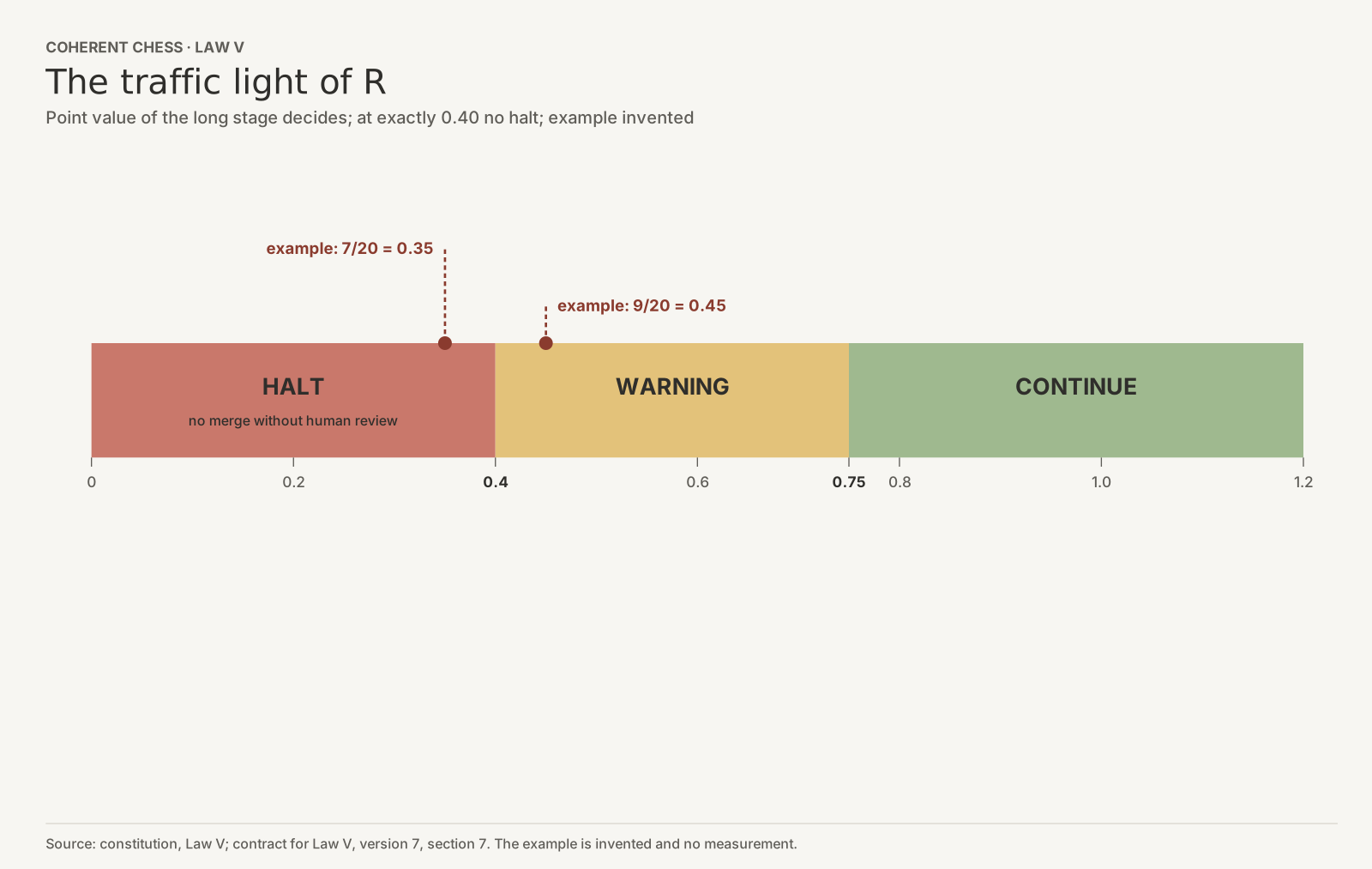
Law V reads, in translation: "If R falls below 0.40, the system halts. R = measured gain against a fixed, external reference divided by the sum of the claimed gains since the last check. R ≥ 0.75 continue · 0.40 to 0.75 warning · R < 0.40 HALT, no merge without human review."
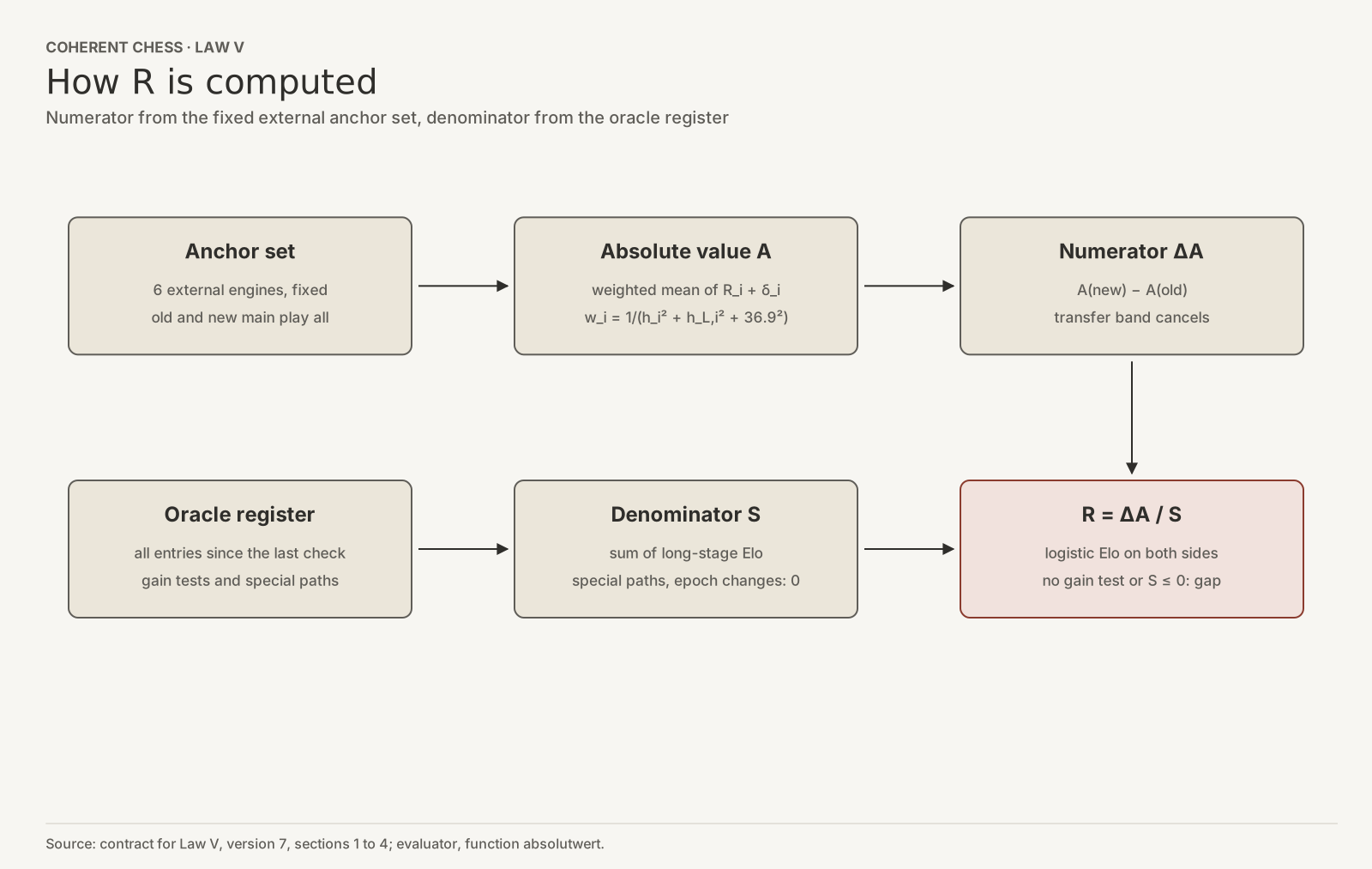
In short, R = ΔA / S. How the numerator and the denominator are formed is fixed in advance in a separate contract for Law V. This entry follows its version 7 of 2026-10-16; a later version applies only from the next check on. The following version 8 of 2026-10-19 does not change the weights, the uncertainty or the band.
The numerator: gain against the anchor set
- The reference is a fixed anchor set of
6external engines. The old and the new main version are both measured against this set under the same conditions. The identifying fields of every anchor, from its name and hash to its fixed rating and that rating's uncertainty, must match the fixed set at both endpoints; otherwise the check is defective. - The absolute value of a version is a weighted mean:
A = Σ wᵢ·(Rᵢ + δᵢ) / Σ wᵢwithwᵢ = 1/(hᵢ² + h_L,ᵢ² + T²)andT = 36.9. HereRᵢis the fixed rating of anchoriandh_L,ᵢits uncertainty;δᵢis the measured Elo Strength difference to the opponent, estimated from the games, with a 95-percent half-width where the oracle reported one. Never an absolute rating. distance of the main version to anchoriandhᵢits statistical uncertainty. - The gain is
ΔA = A(new) − A(old). Its uncertainty is√(σ_old² + σ_new²)withσ = 1/√Σ 1/(hᵢ² + h_L,ᵢ²). - The total band of an absolute value also contains a transfer band of
51Elo. It is the same at both endpoints and cancels in the difference.
The denominator: claimed gains
- The window holds all register entries since the last check up to the current one. The register must contain the window without gaps.
- A gain test passed both stages, short and long. It counts with the oracle value of the long stage in logistic Elo; the short stage is only recorded.
- Special paths can be promoted without a demonstrated Elo gain; they count zero: edge cases including speed changes, playing settings and simplifications. Epoch changes of the oracle also count zero.
- A reversion does not subtract earlier gains from the denominator.
- Without a counted gain test, or with
S ≤ 0, the result is a gap, not an R.
Scale and traffic light
- Numerator and denominator are both logistic Elo, the numerator against the anchor set, the denominator from the oracle. The factor between them is
1. A second R on the normalised Elo scale is recorded but decides nothing. - The point value of the long stage decides: below
0.40HALT, below0.75WARNING, otherwise CONTINUE. At exactly0.40there is no halt. The short stage is evaluated by the same rule, but the long stage decides. - A Monte Carlo band around R is reported but decides nothing; its
95per cent coverage is not calibrated. Since version7of2026-10-16the wording of the law applies without a band rule.
An invented example
Suppose the oracle has confirmed gains of +20 Elo in total since the last check, and against the anchor set the main version rises by +9 Elo. Then R = 9/20 = 0.45: WARNING. Had it risen by only +7 Elo, R would be 7/20 = 0.35: HALT. These numbers are invented and are no measurement.
Why the system halts
Below 0.40, less than 40 per cent of the gains claimed by the oracle arrive against the fixed external reference. The system then does not continue on its own: there is no merge without human review. The decision rests on the logistic point value of R for the long stage. Separately, the constitution treats a contradiction beyond the fixed band between registered external measurement and registered oracle progress within the window as a suspicion of overfitting. A missing measurement is a gap, not a confirmation, and it does not produce an R.
How this was checked
The facts come from the constitution, Law V and its section on what is measured; from the contract for Law V, version 7, sections 1 to 4 and 7; and from the function of the evaluator that computes the absolute value. An agent of another model family checked the text against the same sources.