SPSA under review: no proven better method
Listen to this post11 min
Created by AI from the text of this post and read by the synthetic voice “Sulafat”; not a word-for-word version, and it may contain errors.
Loading…
Created by AI from the text of this post and read by the synthetic voice “Sulafat”; not a word-for-word version, and it may contain errors.Position and speed stay in this browser and are sent nowhere.
The recording could not be played. Open the audio file
Coherent sets numerical values of its search, such as pruning margins, reductions and extensions, with SPSA. At the operator's request, three model families checked independently on 2026-10-26 whether there is a better tuning method. In addition there is a model calculation on which values should be kept after a tuning. All Elo Strength difference to the opponent, estimated from the games, with a 95-percent half-width where the oracle reported one. Never an absolute rating. numbers in this post are model Elo from a simulation, not a measurement of playing strength.
How SPSA works
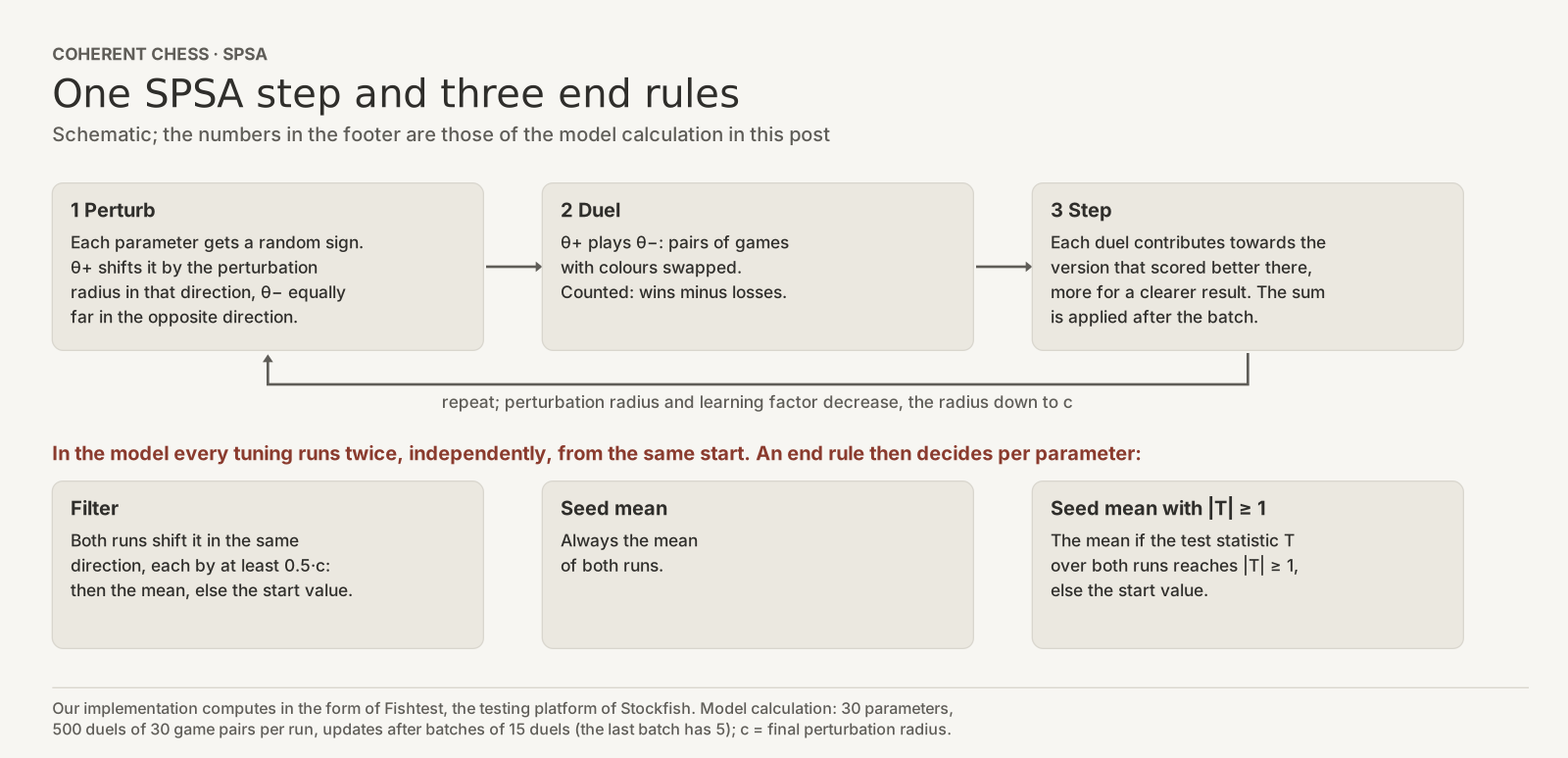
- SPSA stands for "Simultaneous Perturbation Stochastic Approximation": all parameters are changed at the same time in every step.
- Perturb: each parameter gets a random sign. One version of the engine shifts each parameter by the perturbation radius in that direction, the other equally far in the opposite direction.
- Duel: the two versions play pairs of games against each other, with colours swapped. Wins minus losses are counted.
- Step: each duel yields a contribution for all parameters towards the version that scored better in that duel, the larger, the clearer the result. The contributions of several duels are collected and then applied together. Perturbation radius and learning factor decrease in the course of the tuning. This post calls the final perturbation radius
c; below it serves as the unit for the parameters. - Our implementation computes in the form of Fishtest, the testing platform of Stockfish. One review compared it with the Fishtest code and found no calculation error; a second confirms the count of wins minus losses.
Is there a better method?
The search was for a method that yields more playing strength with the same number of games, or the same strength with clearly fewer games. The operator's condition: a replacement must be provably at least as reliable as SPSA. Two families worked with web search, one without network access.
- Result of all three: no replacement method that was checked is proven, or shown in chess, to be better for
30to90parameters at the noise level of our games. - Checked were CMA-ES, Bayesian optimisation, CLOP, 2SPSA, bandit methods and tuning without games.
| Method | Games needed compared with our SPSA form | Basis |
|---|---|---|
| CMA-ES | 1.25 to 5 times | estimate in one review |
| Bayesian optimisation | at least 15 times; more than 200,000 games | rule of thumb from the documentation of a chess tuning tool, in one review; estimate in a second |
| CLOP | clearly more; its quadratic model has 496 coefficients for 30 parameters | estimate in one review |
| 2SPSA | at least 2 times | estimate in one review |
| coordinate-wise or as a bandit | 30 to 89 times | estimate in one review |
The values in the table are estimates from the reviews, not measurements.
The limit of what can be proven
The request also asked what "100 % reliable" would mean and how much of it can be proven.
- Two reviews state: if the result distributions of the better and the worse version overlap, the same observation can occur under both. Then no non-trivial method can decide without error with a finite number of games, SPSA included.
- "
100% reliable" cannot be proven in this sense. What can be proven are asymptotic theorems under assumptions, exact model calculations and the error rates of tests fixed in advance, under their statistical assumptions. - Against regressions of the engine, the fixed measurement stages and the oracle test every candidate, whatever method produced it. Under their statistical assumptions they limit the risk of adopting a regression; they cannot rule it out.
Which values to keep after the tuning?
In the model every tuning runs twice, independently, from the same starting point and with separate random draws. Then one of three end rules decides for each parameter:
- Filter: both runs shift the parameter in the same direction, each by at least
0.5·c. Then the mean of both runs applies, otherwise the start value stays. - Seed mean: always the mean of both runs.
- Seed mean with |T| ≥
1: the mean if the parameter's test statisticTover both runs reaches at least1in magnitude, otherwise the start value.Tis the sum of its individual signals from all duels, divided by the square root of their sum of squares. An individual signal is the signed distance between the parameter's two values in the duel, in units ofc, times the simulated duel result.
The model:
30parameters, each with its own quadratic loss. If a parameter isx·caway from its optimum, this costsL·x² model Elo;Lis log-uniformly distributed between0.05and2for each parameter.- Each parameter is already at its optimum with probability
f, so on average a sharefis. Otherwise its starting error is normally distributed with standard deviations·c, withs=0.5or1.0. - SPSA as in our implementation: per run
500duels of30game pairs each; updates follow batches of15duels, the last batch has5; the learning factor ends at0.002·c². - The duel results are not real games but a linearised Gaussian signal with a fixed variance of
1per game pair. This is a model assumption. 300repetitions per row. "Available" is the model gain if all parameters landed exactly on their optimum.
The more parameters are already right, the smaller the gain; at f = 0.9 the filter is ahead of the unfiltered seed mean. available (all parameters at their optimum): 0 15.24, 0.3 11.2, 0.5 7.87, 0.7 5.25, 0.9 1.71; Filter: 0 9.42, 0.3 7.21, 0.5 4.98, 0.7 3.46, 0.9 1.07; Seed mean: 0 11.76, 0.3 8.66, 0.5 5.9, 0.7 3.84, 0.9 0.93; Seed mean with |T| ≥ 1: 0 11.41, 0.3 8.51, 0.5 5.86, 0.7 3.9, 0.9 1.09.
s | f | available | Filter | Seed mean | Seed mean with |T| ≥ 1 |
|---|---|---|---|---|---|
0.5 | 0 | 3.81 | 1.23 (0.03) | 2.58 (0.00) | 2.29 (0.00) |
0.5 | 0.3 | 2.80 | 0.97 (0.07) | 1.83 (0.03) | 1.71 (0.03) |
0.5 | 0.5 | 1.97 | 0.66 (0.08) | 1.12 (0.12) | 1.10 (0.10) |
0.5 | 0.7 | 1.31 | 0.46 (0.11) | 0.62 (0.30) | 0.68 (0.27) |
0.5 | 0.9 | 0.43 | 0.14 (0.13) | −0.12 (0.74) | 0.04 (0.67) |
1.0 | 0 | 15.24 | 9.42 (0.00) | 11.76 (0.00) | 11.41 (0.00) |
1.0 | 0.3 | 11.20 | 7.21 (0.01) | 8.66 (0.00) | 8.51 (0.00) |
1.0 | 0.5 | 7.87 | 4.98 (0.01) | 5.90 (0.00) | 5.86 (0.00) |
1.0 | 0.7 | 5.25 | 3.46 (0.05) | 3.84 (0.06) | 3.90 (0.07) |
1.0 | 0.9 | 1.71 | 1.07 (0.10) | 0.93 (0.46) | 1.09 (0.38) |
Mean model gain in model Elo; in brackets the share of runs that end with a loss. The standard errors of the means lie between 0.02 and 0.34.
At f = 0.9 the seed mean ends with a loss in 46 % of runs, the filter in 10 %. Filter: 0 0, 0.3 1, 0.5 1, 0.7 5, 0.9 10; Seed mean: 0 0, 0.3 0, 0.5 0, 0.7 6, 0.9 46; Seed mean with |T| ≥ 1: 0 0, 0.3 0, 0.5 0, 0.7 7, 0.9 38.
What the table shows:
- At
f≤0.5the seed mean brings more model gain than the filter for both values ofs. - At
f=0.9the filter brings as much as or more than the unfiltered seed mean. The seed mean then ends with a loss in46% (s=1.0) and74% (s=0.5) of runs. - No rule reaches the available gain. At
s=1.0andf=0the seed mean reaches11.76of15.24model Elo. - So in the model, which end rule brings more depends on the share
f.
What the model does not contain
- the difference between tuning at fixed nodes and play with a clock;
- rounding to whole numbers, the bounds of the parameters, the distribution of results of game pairs, and failed duels;
- real game results.
What is open
- The share
fand the distribution of the lossesLhave not been measured for the engine. - The reviews propose changes to the end rule and variants of SPSA. None of these proposals has been measured, and none has been decided.
How this was checked
- Sources: the three reviews, their summary with addendum, both simulation scripts with their outputs.
- Model without
f: the model table of one review was recalculated with an implementation of its own. Ats=1.0it gave9.27model Elo for the filter and11.45for the seed mean, against9.4and12.3in the review. - Model with
f: only one model family calculated this extension. The fact check by a second family produced both simulation outputs byte-identically with the same scripts and checked the model parameters against our code. For this post the output of the extension was produced byte-identically once more; every number in the table and the charts was checked against it by script. - Limits of the check: the fact check could not repeat the comparison with the Fishtest code itself. The table of replacement methods was checked as the content of the reviews, not as a measurement.
- Independent review: an agent of another model family checked text, tables and figures in
2rounds against the same sources and against our SPSA code. It compared all10table rows and both charts with the simulation output and found them correct. It identified corrections to the description of SPSA, of the model, of the end rules and of the limits of the measurement stages; they have been worked in.