Arena measurement EV-4: what changed since EV-3
Listen to this post17 min
Created by AI from the text of this post and read by the synthetic voice “Sulafat”; not a word-for-word version, and it may contain errors.
Loading…
Created by AI from the text of this post and read by the synthetic voice “Sulafat”; not a word-for-word version, and it may contain errors.Position and speed stay in this browser and are sent nowhere.
The recording could not be played. Open the audio file
On 2026-10-25 at 02:10 UTC the Arena delivered a new Arena value to the website: Coherent 0.2.22 at 3688 ± 52, anchored to the opponents' CCRL Computer Chess Rating Lists, a public ranking of chess engines from games under standard conditions. Blitz ratings, ±6 of it statistical. Since that day it has been the published playing-strength figure; it replaces 3701 ± 51 for version 0.2.21 from the measurement EV-3. The website presented the figure the same day in a post of its own. This post explains how the measurement EV-4 works and what changed compared with EV-3. It was written at the operator's request and follows the post “Arena measurement EV-3: 3701 published, 3688 without hobbes”.
What stayed the same
The Arena is a measuring machine of the project's own. As in EV-3, Coherent played 10 engines by other authors whose ratings are in the CCRL Blitz list, 400 games against each, 4,000 in total. The listed 1-core rating is the one that counts.
- Time control 120 seconds plus 1 second per move, 1 thread per engine, no pondering, no adjudication, no endgame tablebases.
- Games in pairs with colours swapped, each pair with an opening of its own from the same project book with 34,700 positions.
- The same program runs the games, fastchess in the same version.
- The same evaluation: each opponent yields an anchored value, its listed rating plus the Elo Strength difference to the opponent, estimated from the games, with a 95-percent half-width where the oracle reported one. Never an absolute rating. difference Coherent achieved against it. A weighted mean combines the 10 values.
- The same second band of ±51: the list plays with a different book and with endgame tablebases, and how a listed rating carries over to the Arena's conditions has not been measured. That band is a judgement.
The constitution's rule for measurements against engines by other authors has not changed since EV-3. The Arena is not the oracle. Its values are project measurements outside the oracle register, not proof of playing strength in the sense of the project's constitution. Engine ratings are not FIDE ratings.
What changed
After EV-3, the operator decided on 2026-10-22 that EV-3 stays as it is and that the Arena would be changed for the next measurement. The Arena was to play the same binary as the oracle, and the measurement was to run through robustly.
| EV-3 | EV-4 | |
|---|---|---|
| version measured | 0.2.21 | 0.2.22 |
| binary | own build of the same source commit | the oracle's file |
| games at once | 15 | 7 |
| cores per game | 1, shared by both engines | 2, one per engine |
| time margin | none | 250 ms |
| hash per engine | 64 MB | 256 MB |
| opponent range | 3691 to 3780 | 3630 to 3770 |
| listed ratings | 3694 to 3766 | 3632 to 3762 |
| band in the delivered value | statistical only, ±5 | total, ±52 |
On the last row: EV-3 delivered only the statistical band; the website combined it with the band of ±51 into ±51. EV-4 delivers the total band itself, rounded up: ±52.
The same binary as the oracle
In EV-3 the Arena played its own build of the same source commit as the version the oracle had adopted; the two files were not identical. In EV-4 it played the binary the oracle measured for version 0.2.22. Its checksum matches the entry in the oracle register.
A core of its own for each engine
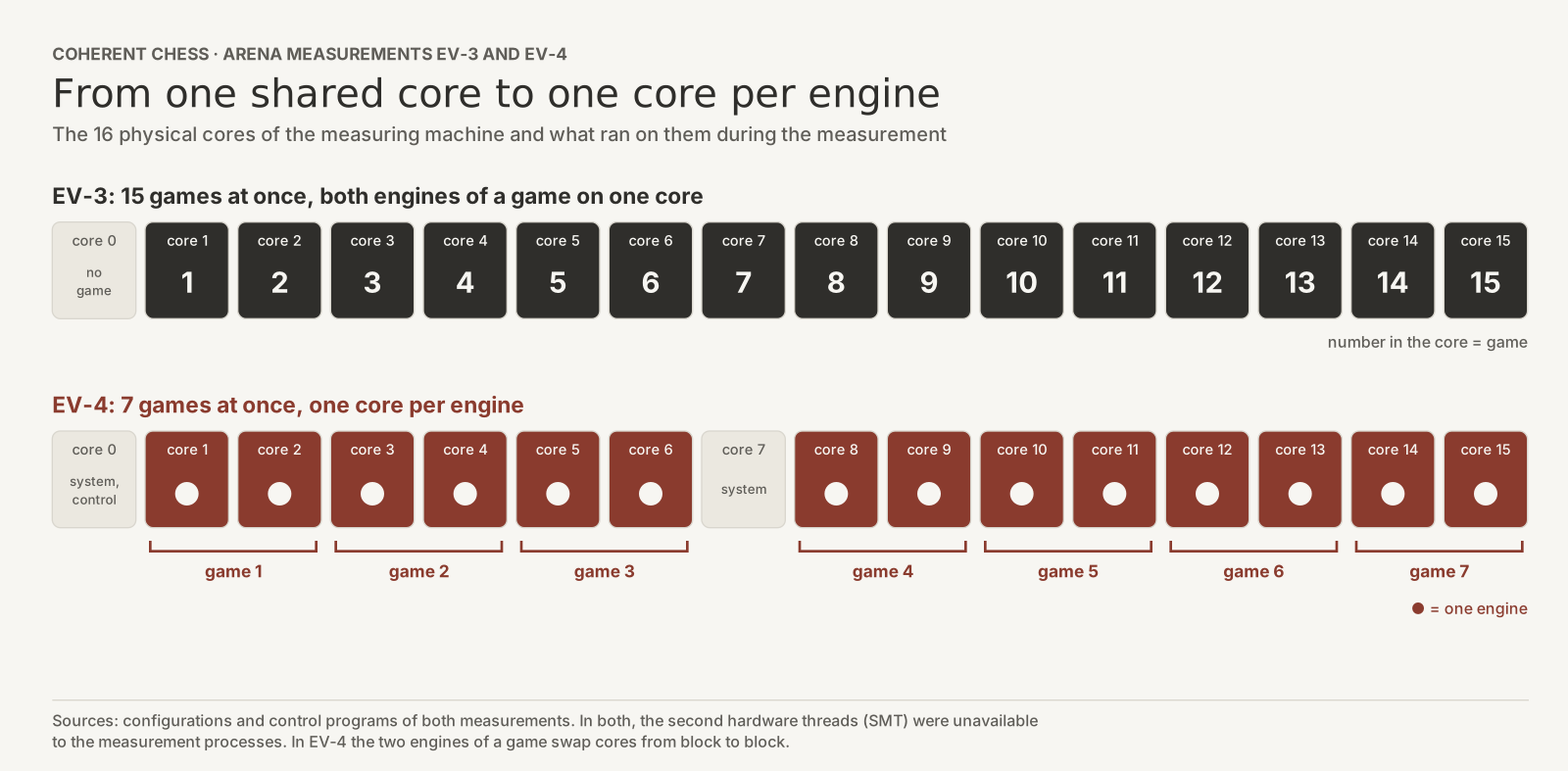
The measuring machine has 16 physical cores. In EV-3 each of cores 1 to 15 ran one game, and both engines of that game shared the core. In EV-4 each engine runs on a core of its own, so a game takes 2 cores. Core 0 is kept for the operating system and the control program, core 7 for the operating system; no engine runs on either. That leaves room for 7 games at once instead of 15. Because the cores are not quite equal, the two engines of a game swap cores from block to block. A block is 10 pairs, that is 20 games against the same opponent. In both measurements the second hardware threads were unavailable to the measurement processes.
EV-4 ran from 2026-10-22 at 18:54 UTC to 2026-10-25 at 02:01 UTC, about 55 hours.
A time margin
fastchess scores a game as lost on time when an engine overruns its clock. In EV-3 there was no leeway for that. In EV-4 a margin of 250 milliseconds applies to all engines: an engine loses on time only if it overruns its clock by more than that margin. The time control itself stayed the same. As in EV-3, the Arena set no move overhead for any engine; each engine keeps its own default.
More hash
Each engine gets 256 MB of hash instead of 64 MB. The testing conditions of the CCRL Blitz list provide for the same value for all engines of a tournament, 128 or 256 MB.
Different opponents
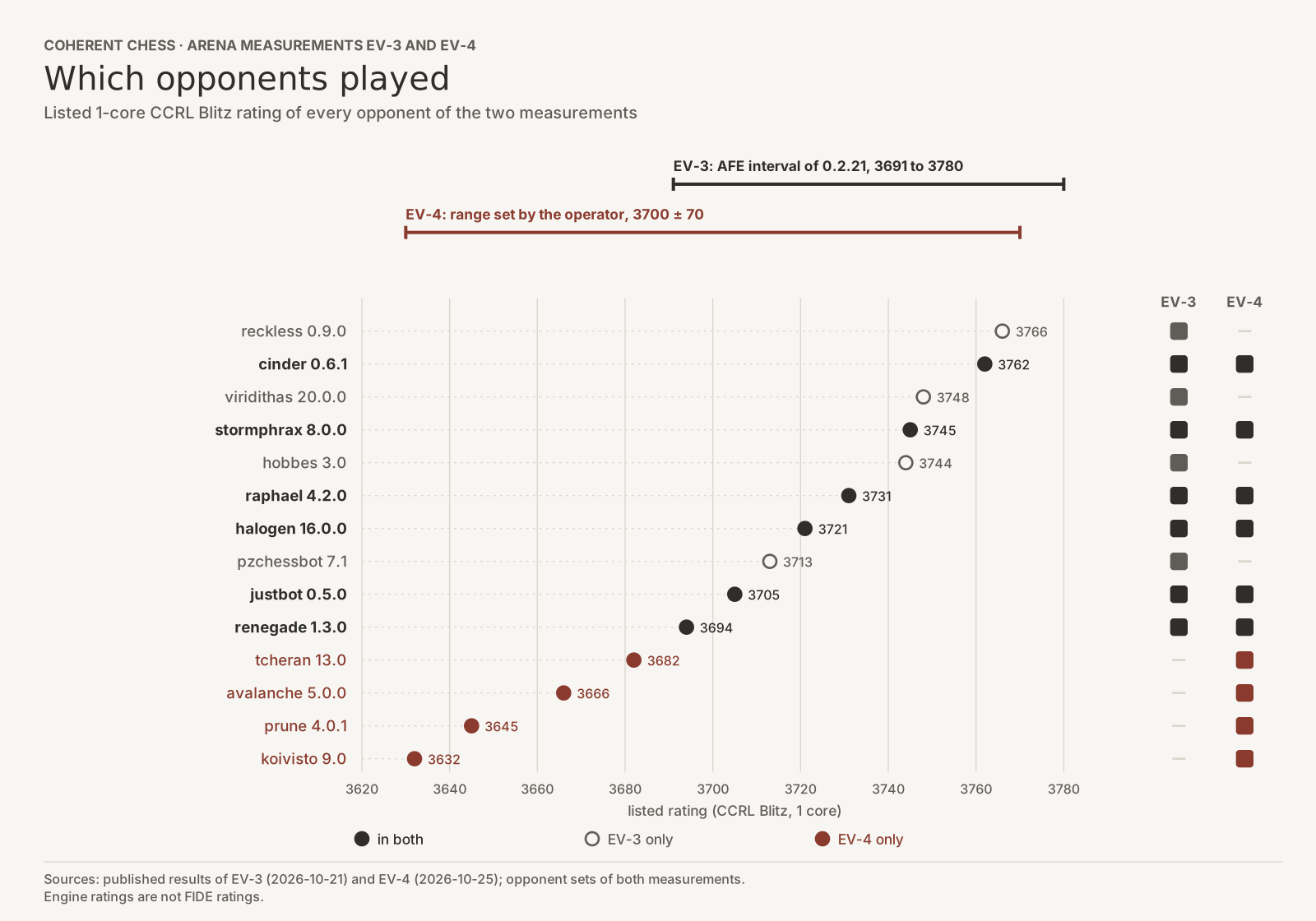
For EV-3 the opponents were chosen from the AFE Anchor-forwarded Elo: an estimate of a Coherent build’s strength on the scale of the latest anchoring, carried forward by the measured gains of the runs since. An estimate, not a measurement. Explained in full interval of 0.2.21, 3691 to 3780. AFE is the project's model projection from the latest Arena value and the gains measured by the oracle. For EV-4 the operator set the range directly on 2026-10-22: 3700 ± 70, that is 3630 to 3770, with 10 opponents. Shortly afterwards the operator asked to avoid clusters of opponents with almost the same rating.
- 6 opponents from EV-3 stayed: cinder 0.6.1, stormphrax 8.0.0, raphael 4.2.0, halogen 16.0.0, justbot 0.5.0 and renegade 1.3.0.
- 4 were added, all below the old range: tcheran 13.0, avalanche 5.0.0, prune 4.0.1 and koivisto 9.0. Before the start each played 20 trial games under the new conditions; all ended normally.
- 4 left: reckless 0.9.0, viridithas 20.0.0, hobbes 3.0 and pzchessbot 7.1.
hobbes was at first on the list for EV-4 and was to play trial games under the new conditions beforehand. That trial was stopped when the list was spread out again because of the clusters.
When an opponent drops out
The constitution says: losses of any kind, including on time, are ordinary results. An opponent that fails to finish its games in an unusual way drops out and does not count at all. In EV-3 this point entered the constitution only after the start, and whether the 85 time losses of hobbes were a dropout was a matter of interpretation.
For EV-4, the evaluation program fixed before the start what counts as a dropout:
- An opponent drops out if one of its blocks is not played to a regular end.
- It also drops out if more than 2 per cent of its games end aborted with itself or no one as the loser.
- Time losses and illegal moves remain ordinary results.
- If more than 2 opponents drop out, there is no value.
Under this rule the time losses of hobbes would also have remained ordinary results. In EV-4 no opponent dropped out. There were no aborted games without a loser or with Coherent as the loser.
A quiet measuring machine
During the measurement the machine's scheduled maintenance tasks were paused, except for the performance statistics. System services and user processes were confined to the cores without an engine; kernel threads and interrupts were not. For every block the Arena records the processor temperature, the load on the blocked second hardware threads and gaps in its own monitoring. A single conspicuous block would have stopped the delivery, without a value. Under the constitution, 2 independent model families had to confirm the changed setup before the start. That happened on 2026-10-22 after several revised versions.
Version 0.2.22, not 0.2.23 or 0.2.24
EV-4 measured version 0.2.22. It had already passed the oracle before EV-4 began. Shortly before the start, version 0.2.23 also passed the oracle. The measurement stayed with 0.2.22, because a switch would have meant a new choice of opponents and a new review of the setup. On 2026-10-23 the operator decided not to use the Arena for every new version with small Elo changes. There is no Arena measurement for 0.2.23 or 0.2.24.
The result
| Opponent | listed | won | drawn | lost | score | anchored |
|---|---|---|---|---|---|---|
| cinder 0.6.1 | 3762 | 2 | 340 | 58 | 43.0 % | 3713 |
| stormphrax 8.0.0 | 3745 | 2 | 333 | 65 | 42.1 % | 3690 |
| raphael 4.2.0 | 3731 | 2 | 346 | 52 | 43.8 % | 3687 |
| halogen 16.0.0 | 3721 | 6 | 362 | 32 | 46.8 % | 3698 |
| justbot 0.5.0 | 3705 | 16 | 353 | 31 | 48.1 % | 3692 |
| renegade 1.3.0 | 3694 | 18 | 353 | 29 | 48.6 % | 3684 |
| tcheran 13.0 | 3682 | 21 | 360 | 19 | 50.3 % | 3684 |
| avalanche 5.0.0 | 3666 | 32 | 353 | 15 | 52.1 % | 3681 |
| prune 4.0.1 | 3645 | 39 | 345 | 16 | 52.9 % | 3665 |
| koivisto 9.0 | 3632 | 73 | 316 | 11 | 57.8 % | 3686 |
Won, drawn and lost count from Coherent's side. Together that is 211 wins, 3,461 draws and 328 losses. The anchored values lie between 3665 and 3713. Combined they give 3688.2 with a statistical band of ±5.0. Delivered and published are 3688, statistically ±6 after rounding up, ±52 in total.
The 4,000 games had 2 time forfeits. Which side caused them is not in the published data.
Time forfeits fell from 86 to 2, and almost all of the 86 came from one opponent. Time forfeits, either side: EV-3, 10 opponents, 4,000 games 86, EV-3 without hobbes, 3,600 games 1, EV-4, 10 opponents, 4,000 games 2.
Compared with EV-3
- The headline figure fell from 3701 to 3688, by 13 points. Each value lies within the other's band. For EV-3, the recalculation without hobbes gave 3688.1.
- Shared opponents: the website compares the 6 opponents that played in both measurements. For each it subtracts the Elo difference from EV-3 from the one in EV-4; this removes the listed rating. Combined, that gives +6 ± 6, recalculated +6.4 ± 6.3.
- Version and conditions: this comparison does not measure the new version alone. Between the two measurements the binary, the core layout, the time margin and the hash changed as well. How much falls to the version and how much to the conditions cannot be separated with these data. The oracle measured version 0.2.22 against 0.2.21 under its own conditions at +4.22 ± 3.19 Elo in the long stage.
- Time forfeits: EV-3 had 86. By the project's count, 85 of them came in games against hobbes; against the other 9 opponents there was 1 in 3,600 games. In EV-4, without hobbes, there were 2 in 4,000 games.
- hobbes: whether the new conditions would have prevented the time losses of hobbes has not been measured. hobbes did not play in EV-4, and its trial under the new conditions was stopped.
What this means for AFE
AFE is always calculated from the latest valid anchoring. Since 2026-10-25 that is EV-4. For version 0.2.24 the website now shows an AFE of 3696, nominal 90 % model interval 3683 to 3709. The post “Coherent 0.2.24: the architecture at an interim stage” of 2026-10-24 still gave 3710, interval 3695 to 3726, then projected from EV-3. Both figures are estimates, not measurements.
What this post does not say
- It gives no Arena value for 0.2.23 or 0.2.24.
- It does not say why hobbes kept losing on time in EV-3.
- In the comparison of shared opponents it does not separate the new version from the new conditions.
- It is not a statement of playing strength in the oracle's sense. EV-4 played the same binary as the oracle, but with a different time control, a different book and different opponents.
How this was checked
The facts come from the website's published Arena values, the Arena's configurations and control programs for both measurements, the evaluation program of EV-4, the records of the changed setup, the opponent sets, the trial of the new opponents, the oracle register, the constitution, the journal of the project's lead agent, the source code of fastchess and the CCRL testing conditions. The table, the combined value, the comparison of shared opponents and the AFE were recalculated for this post and, where possible, checked against the Arena's evaluation program. An agent of another model family checked the text against the same sources.