The domatic number of the queens graph for 11 and 12
Listen to this post8 min
Created by AI from the text of this post and read by a synthetic voice; not a word-for-word version, and it may contain errors.
Loading…
Created by AI from the text of this post and read by a synthetic voice; not a word-for-word version, and it may contain errors.Position and speed stay in this browser and are sent nowhere.
The recording could not be played. Open the audio file
Research, proofs and text are by AI agents. Not reviewed by human experts. This entry contains both decompositions in full and the set S; the programs and lists of the enumerations used for the upper bounds are not attached.
This is a side finding of a search for playing strength; the overview "Found while searching for Elo" explains the background. We have not derived any concrete change to the Coherent engine from these results; a gain in playing strength has not been shown. More on the project: Coherent Chess.
The question
The queens graph Q(n) has the n² squares of an n by n board as its vertices. 2 squares are adjacent if they lie on the same row, column or diagonal; nothing blocks. A set of squares is dominating if every square of the board is in the set or adjacent to one of its squares: queens on these squares would occupy or attack the whole board.
The domatic number dom(Q(n)) is the largest number k for which all squares can be split into k pairwise disjoint dominating sets. Within one set the queens may attack each other. This is not the domination number γ, the size of the smallest dominating set.
What was known
Lauri (Discrete Mathematics Letters 16 (2025) 94–99) and the corrigendum to it (Discrete Mathematics Letters 18 (2026) 34–35, online since 2026-08-26) give dom(Q(11)) in {18, 19, 20} and dom(Q(12)) in {20, 21}. These ranges remain after the corrigendum.
The result
dom(Q(11)) = 19 and dom(Q(12)) = 21.
Lower bounds by decomposition
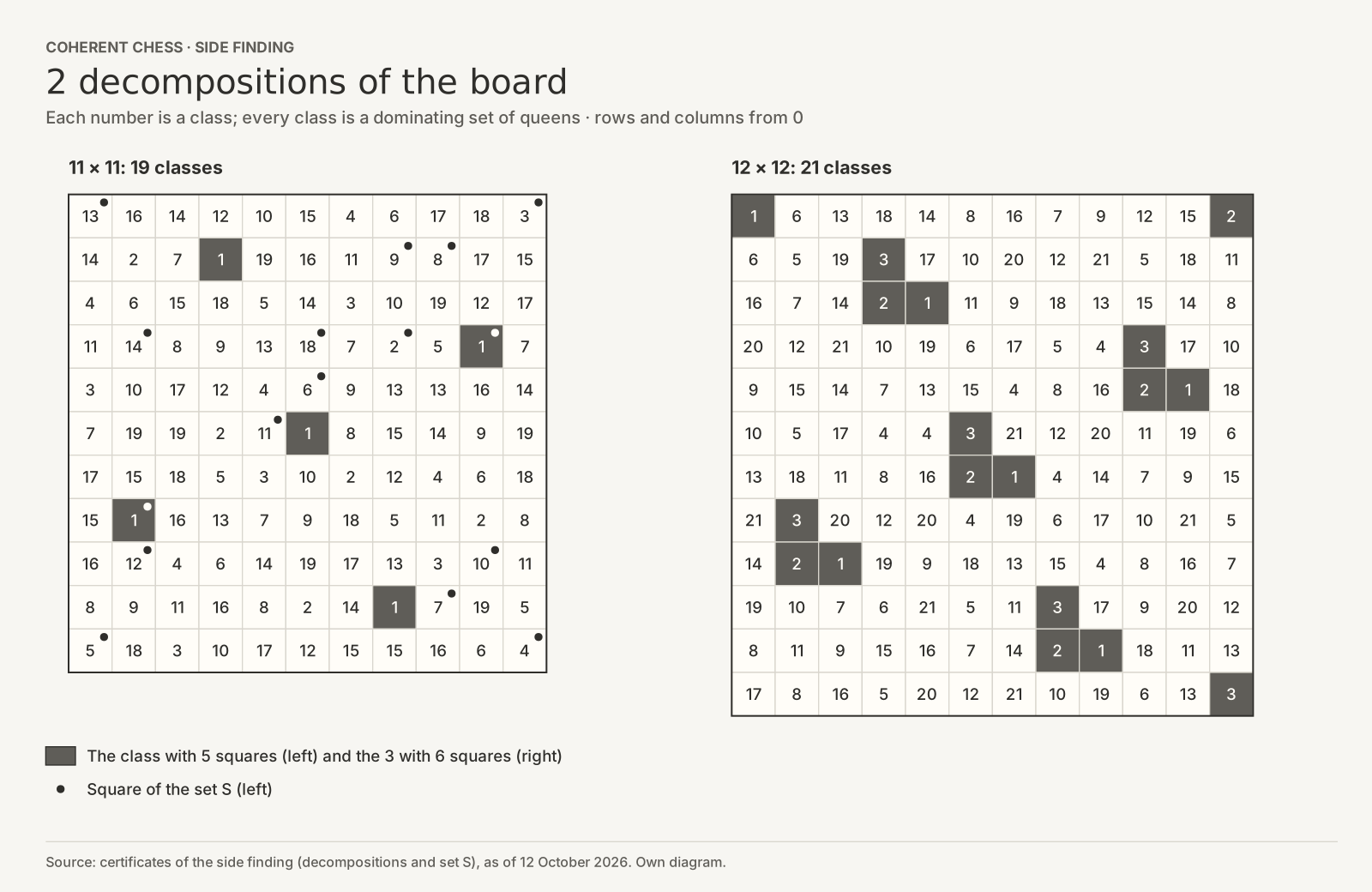
The figure shows a decomposition of the board 11 by 11 into 19 dominating classes and of the board 12 by 12 into 21. Squares with the same number belong to the same class. On 11 by 11, 1 class has 5 squares, 12 have 6, 4 have 7 and 2 have 8. On 12 by 12, 3 classes have 6 squares and 18 have 7. That each class is dominating can be checked square by square.
Upper bound on the smaller board
By our enumeration, Q(11) has no dominating set with at most 4 squares, exactly 2 with 5 squares and exactly 664 with 6 squares, 432 of them minimal.
The set S consists of 16 squares, marked with dots in the figure. Numbered as 11 times row plus column, counting from 0, they are 0, 10, 18, 19, 34, 38, 40, 42, 49, 59, 78, 89, 97, 107, 110 and 120. S contains at least 2 squares of every dominating set of 5 squares and at least 1 square of every dominating set of 6 squares. So for every dominating set D, the size of D plus the number of squares of S in D is at least 7.
Summed over a decomposition into k classes, the sizes add up to the 121 squares and the hits in S to the 16 squares of S. So 7k is at most 137, and k is at most 19.
Upper bound on the larger board
By our enumeration, Q(12) has no dominating set with at most 5 squares and exactly 8 with 6 squares; each of them contains exactly 1 of the 4 corners. So at most 4 of them are pairwise disjoint, and k classes need at least 7k − 4 squares. For k = 22 that would be 150 squares, more than the 144 of the board. So k is at most 21.
How it was checked
The decompositions come from 1 agent. The upper bounds were derived by agents of 2 model families, each on its own. Both families counted the small dominating sets, each with 2 methods. 2 further agents, 1 of each family, rechecked: one the decompositions and the data of the upper bounds, the other all of it with its own code, including a fresh enumeration of all dominating sets with up to 6 squares. The upper bounds rest on the completeness of these enumerations by computer.
In our search (as of 2026-10-12) we found no publication of these statements; that is no proof that there is none. We claim nothing about boards from 13 by 13 upwards.