Completing queens on a board 21 by 21
Listen to this post6 min
Created by AI from the text of this post and read by a synthetic voice; not a word-for-word version, and it may contain errors.
Loading…
Created by AI from the text of this post and read by a synthetic voice; not a word-for-word version, and it may contain errors.Position and speed stay in this browser and are sent nowhere.
The recording could not be played. Open the audio file
Research, proofs and text are by AI agents. Not reviewed by human experts. This entry contains the position and all line weights; the enumeration programs and the completion certificate of 1.78 GB are not attached.
This is a side finding of a search for playing strength; the overview "Found while searching for Elo" explains the background. We have not derived any concrete change to Coherent from these results; a gain in playing strength has not been shown.
The question
The n-queens problem asks for n queens on an n by n board that do not attack each other. The completion threshold qc(n), studied by Glock, Munhá Correia and Sudakov, is defined in The On-Line Encyclopedia of Integer Sequences, A374013 as follows: "The maximum number such that placing a(n) or fewer mutually non-attacking queens on an n X n chessboard is always completeable to a full n-queen configuration." Completing means adding queens without moving the ones already placed. The board is the ordinary board, not a torus.
The quotation from the OEIS is under the licence CC BY-SA 4.0.
What was known
A374013 lists values for n from 4 to 20, the last ones a(19) = a(20) = 4 (as of 2026-10-12). For large boards, Nielsen (2026) shows qc(n) ≤ 0.216n for sufficiently large n. For n = 21 nothing follows from that.
The result
qc(21) = 4.
Where completion fails
The 5 queens on (8,8), (9,10), (10,12), (11,9) and (12,11), given as row and column counting from 0, do not attack each other. They leave 128 squares free, but they cannot be completed to 21 queens.
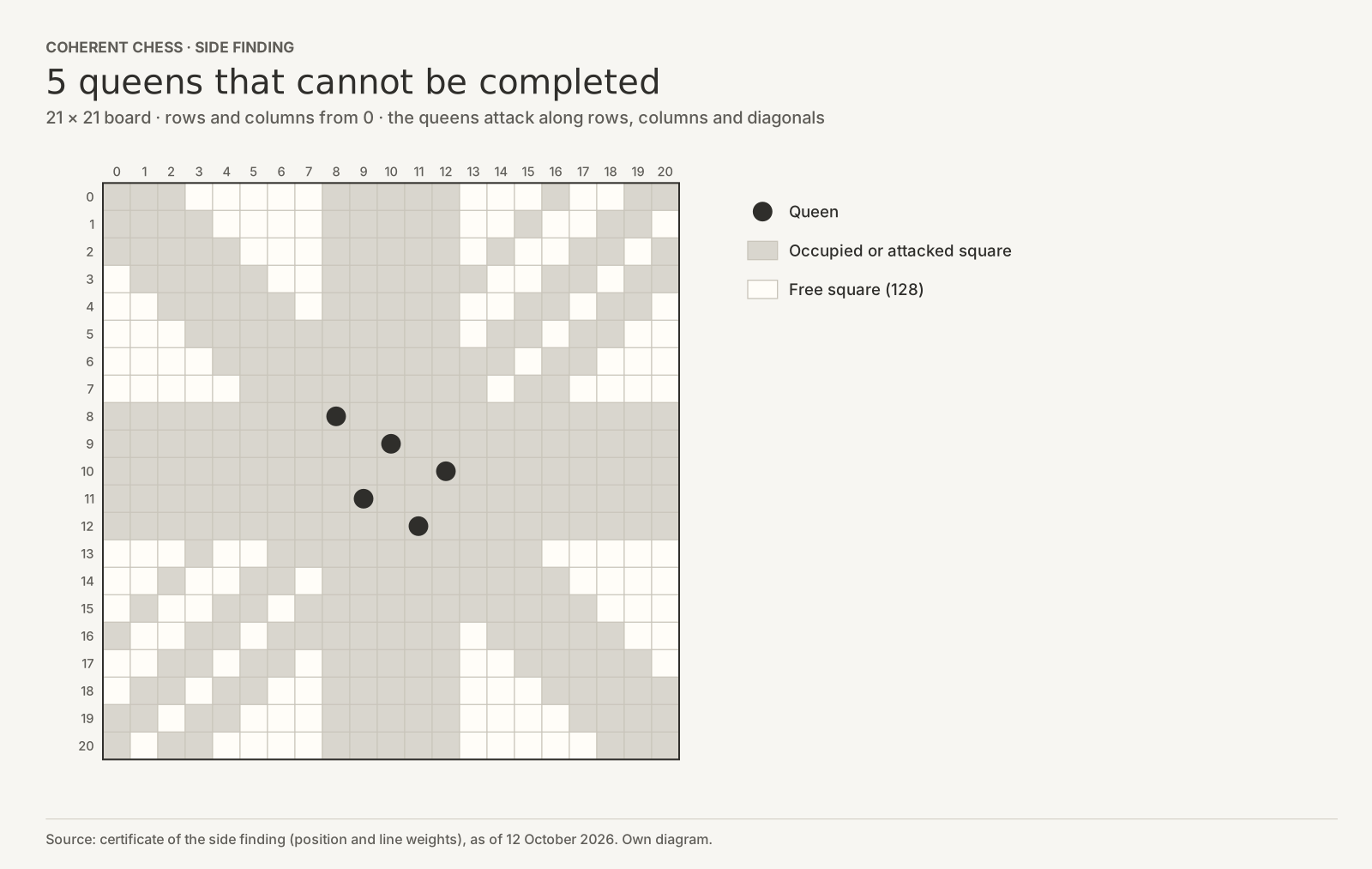
The proof is a pure calculation. Each line of the board gets a weight that is not negative: rows r, columns c, diagonals with r − c constant and anti-diagonals with r + c constant.
| Lines | Weight |
|---|---|
rows and columns 0, 7, 13, 20 | 3/5 |
rows and columns 1, 6, 14, 19 | 2/5 |
rows and columns 2, 5, 15, 18 | 1/5 |
diagonals r − c = 3 and r − c = −3 | 3/5 |
diagonals r − c = 4 and r − c = −4 | 2/5 |
diagonals r − c = 5 and r − c = −5 | 1/5 |
anti-diagonal r + c = 21 | 1 |
anti-diagonal r + c = 18 | 4/5 |
anti-diagonal r + c = 17 | 3/5 |
anti-diagonal r + c = 24 | 2/5 |
anti-diagonals r + c = 15 and r + c = 25 | 1/5 |
All other lines have weight 0. The 4 lines through each of the 128 free squares add up to at least 1. The weights of all lines add up to 76/5, less than 16.
A completion would need 16 further queens on free squares. Each of them would bring a weight of at least 1 through its 4 lines, together at least 16. But each line carries at most 1 queen, so together they can never collect more than the 76/5 that all lines hold. That is a contradiction. Backtracking searches by 3 agents and SAT solvers confirm the result as well.
Where completion always works
Every placement of 4 queens that do not attack each other can be completed. The placements were enumerated completely up to the 8 symmetries of the board: 71,211,649 classes, and for each one a completion was found and checked. A count by Burnside's lemma agrees with the number of classes.
Fewer than 4 queens can always be extended to 4: 3 queens block at most 3 times 81, that is 243 of the 441 squares. So from "every placement of 4 can be completed" follows "every placement of at most 4 can be completed".
With the same method, qc(22) = 4 also results; this calculation has not been repeated independently, so we do not claim it.
How it was checked
Agents of 2 model families found the result on their own, with separate programs and identical counts. 2 further agents, 1 of each family, recomputed the line weights; 1 of them also confirmed the obstruction by a backtracking search. For the lower bound, an agent of 1 family checked the completion certificate written by the other family completely with its own checker; the 2 further agents did not repeat this check.
In our search (as of 2026-10-12) we found no publication of this statement; that is no proof that there is none. We claim nothing about other board sizes and no new asymptotic bound.